
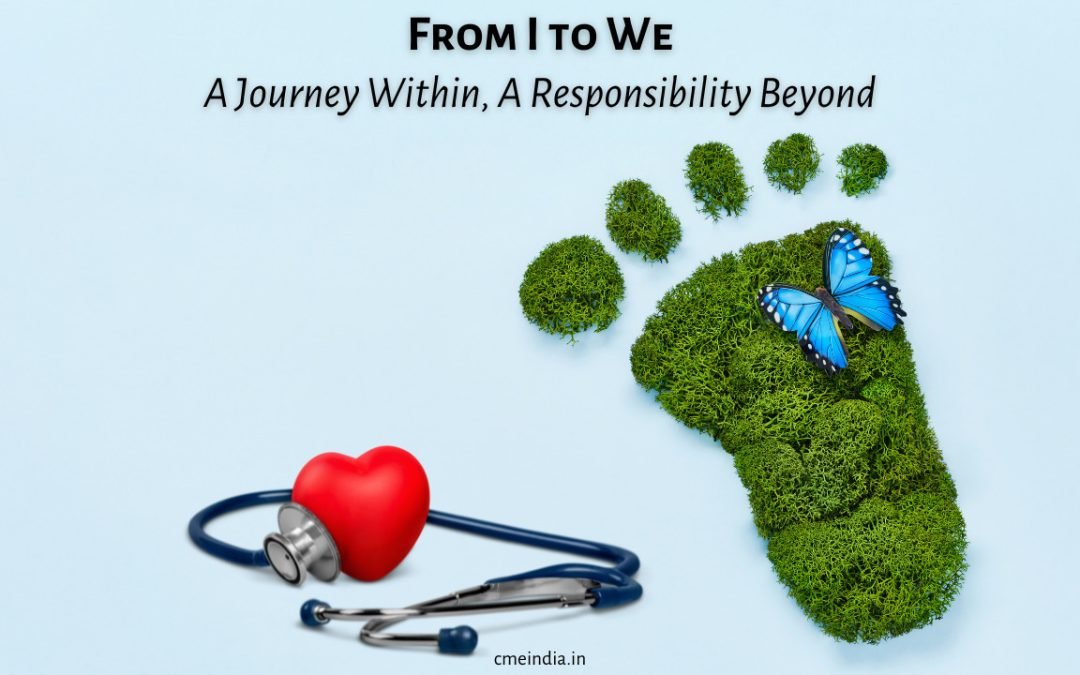
CME INDIA Presentation by Dr. Shambo Samrat Samajdar,MBBS MD DM (Clinical Pharmacology) PG Dip Endo & Diabetes (RCP, UK) Consultant, Diabetes & Allergy-Asthma Therapeutics Specialty Clinic, Kolkata; Dr. Shashank R. Joshi, Endocrinologist, Mumbai; Dr. N. K. Singh, Editor-in Chief, CME INDIA, Dhanbad.
Reflections for Physicians on Earth Day 2025.
As physicians, we are trained to heal individuals—diagnose disease, prescribe medicines, monitor vitals, and restore health. But as Earth Day 2025 dawns upon us with the global theme “Our Power, Our Planet”, it becomes imperative to ask: Can there be personal health without planetary health?
The answer—though complex—is resoundingly no.
Our health systems, our clinical outcomes, even our diagnostic patterns are increasingly being influenced by environmental degradation, climate change, pollution, and the unsustainable ways we live and practice. Yet the medical community often remains peripheral in ecological dialogues.
Earth Day is not just a day for environmentalists. It is a day for every healer—because we are not just caretakers of the body, but stewards of the world that sustains it.
The Clinical Impact of Environmental Decline
Let us begin with the facts physicians understand best—data and disease patterns:
Air Pollution is now a Group 1 carcinogen and a leading contributor to COPD, asthma, cardiovascular diseases, and even metabolic syndrome.
Heatwaves and climate shifts have altered the epidemiology of infections, including vector-borne diseases like dengue and scrub typhus.
Endocrine-disrupting chemicals (EDCs) from plastic waste, pesticides, and industrial effluents are now recognized as contributors to obesity, diabetes, and infertility.
Mental health issues are surging in climate-vulnerable zones—highlighting the psychological cost of ecological collapse.
These are not distant crises. They show up in our OPDs, our emergency rooms, our ICUs.
Thus, Earth Day must become a clinical call to action.
Medicine and Environment: The Forgotten Connection
Hippocrates, the father of modern medicine, wrote in “Airs, Waters and Places” about the influence of geography, water quality, and seasonal changes on health. Ancient Indian physicians—Charaka and Sushruta—included chapters on seasonal regimens (ritucharya), harmony with nature (prakriti), and lifestyle alignment with natural elements.
Somewhere along the way, we forgot this. Our stethoscopes grew louder than the rustling of leaves. But if the COVID-19 pandemic taught us anything, it is that a virus doesn’t distinguish between a polluted river and a sterile operating theatre.
Public health is not isolated from planetary health. Rather, they are two sides of the same coin.
From I to We: The Spiritual Medicine
Swami Vivekananda once said: “Don’t believe in God until you feel Him yourself.”
This was not a denial of divinity, but a call to seek experiential truth.
When he met Sri Ramakrishna, he asked, “Have you seen God?”
Sri Ramakrishna replied, “Yes, and I can help you see Him too.”
Their dialogue wasn’t about religion. It was about realization.
Vedanta guides us to ask: “Who am I?”
And the answer that arises: Tat Tvam Asi—“You are That.”
Or more boldly: Aham Brahmasmi—“I am Divine.”
The implications for a physician are profound. If divinity resides within us, so it does in our patients, in the trees, the soil, the air we breathe.
This realization leads to a shift from ego to eco, from individual health to collective wellness, from “I” to “We.”
The Physician’s Pledge on Earth Day 2025
This Earth Day, the global community is calling for a tripling of renewable energy capacity by 2030, and an urgent transition to clean energy—solar, wind, hydro, geothermal, and tidal. While these policy-level shifts are crucial, the healthcare fraternity too has a unique role to play.
We need a new kind of clinical leadership—one that views planetary stewardship as preventive medicine.
1. Climate-Smart Healthcare Practices
- Hospitals consume enormous energy and generate significant biomedical and plastic waste.
- Green hospital certifications, solar-powered units, sustainable procurement, and biodegradable packaging should become institutional norms.
2. Prescribing Nature
- Encourage patients to reconnect with green spaces.
- Nature-based prescriptions for mental wellness, circadian alignment, and post-COVID rehabilitation are evidence-backed.
3. Physician Advocacy
- Advocate for cleaner air and water regulations.
- Join or initiate conversations around urban planning, sanitation, and vector control.
4. Medical Education Reform
- Integrate climate and environmental health into undergraduate and postgraduate curricula.
- Promote intersectoral dialogue between medicine, environmental science, and public policy.
From Clinical Protocols to Planetary Dharma
In Indian philosophy, dharma refers to the cosmic law or duty that upholds order. As physicians, our dharma has always been “do no harm.” But now we must expand it to: “cause no harm to the Earth.”
Take the example of diabetes—a condition we encounter every day.
- Urbanization, processed foods, and sedentary lives have driven the diabetes epidemic.
- But poor urban air quality worsens insulin resistance.
- Reduced biodiversity limits dietary diversity, and climate-induced food scarcity is undermining nutrition.
The very metabolic dysregulation we treat is, in many ways, a symptom of ecological imbalance.
The Power of Personal Action
You don’t need to be an environmentalist to protect the Earth. You need only be aware.
Here are a few physician-led actions that can make a difference:
- Reduce clinic plastic use: Encourage patients to carry reusable reports or access digital records.
- Teleconsultation: Reduces carbon footprint from transport and unnecessary travel.
- Community health walks: Organize neighborhood walks promoting both health and green spaces.
- Solar panels in clinics: Many practices are now shifting to partial solar dependency.
- Sustainable conference culture: Reduce paper use, cut down on waste, opt for plant-based meals during CMEs.
Small actions by thousands of physicians will ripple into systemic change.
Healing the Healer
Burnout among physicians is a silent epidemic.
But reconnection with nature—“rewilding the soul”—has been shown to reduce stress, restore purpose, and foster deeper empathy.
- A moment under a tree after clinic hours.
- A breath of sunrise air before hospital rounds.
- A pause to hear birdsong amid the rush of prescriptions.
- These are not luxuries. These are restorative therapies.
Just as the planet needs healing, so do we.
And perhaps the two journeys—inner and outer—are one and the same.
Closing Reflection: Towards a Planetary Prescription Pad
Earth Day 2025 is not just a calendar date. It is a mirror.
It asks us, as physicians: What are we healing? And for whom?
If our science is not grounded in sustainability, if our health goals ignore climate realities, and if our treatment ends at the skin—then we are missing the larger diagnosis.
Let us remember the words of a monk who once said, “Your very existence is the proof that God exists.”
Then the rivers, forests, oceans, and stars—all part of existence—are divine too.
This Earth Day, let us take the journey from “I” to “We.”
From the illness of disconnection to the wellness of unity.
Because the greatest prescription we can write today is one that says:
“Heal thyself, heal the Earth.”
Discover CME INDIA

- Explore CME INDIA Repository
- Examine CME INDIA Case Study
- Read History Today in Medicine
- Register for Future CMEs
I feel this article is quite thought provoking. But I am quite suspicious about its application in day to day life.
Particularly I am not very sure about practicing physicians to give enough time to this new approach.
Hope you succeed.
All the best wishes for this new approach.
Very nice and thoughtful article. As we are going away from the nature, our health issues are rising. We should be trained to respect our surroundings and life is to live with better understanding of the environment around us. Diseases are healed by the system we possess within us.
This article is a great reminder to all of us that our behaviour and our day to day activities should be environment friendly