
CME INDIA Presentation by Dr. Shambo Samrat Samajdar,MBBS MD DM (Clinical Pharmacology) PG Dip Endo & Diabetes (RCP, UK) Consultant, Diabetes & Allergy-Asthma Therapeutics Specialty Clinic, Kolkata; Dr. Shashank R. Joshi, Endocrinologist, Mumbai; Dr. N. K. Singh, Editor-in Chief, CME INDIA, Dhanbad.
An eternal template
On the sacred occasion of Rama Navami, we remember not merely the birth of a princely avatar, but the divine descent of Dharma itself—Maryada Purushottam Shri Rama, the upholder of truth, humility, and cosmic order. For the modern physician, Rama’s life is more than a tale—it is an eternal template, a timeless archetype of how to live, lead, serve, and heal. As healers walk the tightrope of science and service, skill and stress, the figure of Rama whispers a deeper truth: To serve without ego, to heal without fear, and to walk with both steadiness and surrender.
Let us walk this sacred path through the evocative verses of the Ramāṣṭakam, composed by Vyasa, each a mirror into the soul of medicine when illumined by spirituality.
I. “भजे विशेषसुन्दरं समस्तपापखण्डनम्।”
I bow to the exquisitely beautiful One, the destroyer of all sin.
The physician’s presence should feel like balm—comforting, reassuring, aesthetically attuned to the patient’s unspoken fears. The verse reminds us that true beauty lies in virtue, in kindness, in the ability to listen deeply. As Rama destroyed the sins of those who came to him, the physician, through wisdom and compassion, becomes an instrument to relieve karmic burdens of pain, disease, and fear.
II. “स्वभक्तचित्तरञ्जनं सदैव राममद्वयम्।”
The One who delights the hearts of devotees—I ever bow to that indivisible Rama.
What does it mean to “delight” the hearts of others? For a doctor, this is not jest or charm—it is the radiance of silent empathy, the stillness in the midst of a crisis, the gentle reassurance that flows not from textbooks but from a soul grounded in inner clarity. Healing, then, is not a transaction—it is a sacred offering.
III. “निजस्वरूपबोधकं कृपाकरं भवापहम्।”
He who grants realization of the Self, bestows grace, and removes worldly bondage.
In the flicker of awareness that occurs during suffering, the healer becomes a guide—sometimes unknowingly—towards self-realization and surrender. Rama reminds the physician to be rooted in their own true nature, for only one who has seen light within can reflect it outside.
IV. “सहप्रपञ्चकल्पितं ह्यनामरूपवास्तवम्।”
Though appearing with the world, he is beyond name and form.
This is where science meets transcendence. The human body is anatomy and physiology—but also silence, breath, memory, karma. A doctor who sees the patient merely as a clinical subject sees only half. Rama teaches non-duality—the world of forms exists, but the truth lies beyond them. Likewise, behind every symptom, there is a person, and beyond that person, a soul.
V. “निष्प्रपञ्चनिर्विकल्पनिर्मलं निरामयम्।”
He is pure, beyond the world, without duality or disease.
To aspire to such a state is the path of the yogi—but even the physician, amidst the bustle of modern medicine, must cultivate a moment of stillness. In that stillness—perhaps between two patients, or at dawn before the hospital rush—there lies the secret of spiritual resilience. A doctor who is emotionally healed can heal others far more profoundly than one merely practicing protocol.
VI. “भवाब्धिपोतरूपकं ह्यशेषदेहकल्पितम्।”
He is the boat across the ocean of becoming, imagined in countless forms.
Medicine is often described as a ‘calling.’ But what is it calling us toward? Not wealth, not power—but liberation through service. Rama becomes the boat, and the doctor becomes the boatman. Patients come with their waves of suffering, and the physician’s task is not just to diagnose but to carry them across, with hands made steady by skill and a heart anchored in surrender.
VII. “महावाक्यबोधकैर्विराजमनवाक्पदैः।”
He shines forth in the great Upanishadic statements, beyond speech.
There is a moment every physician faces when words fail—at the edge of death, in front of a weeping mother, in the silence of a terminal diagnosis. In those moments, the training of the soul surpasses all training of the mind. Rama, the embodiment of Vedic wisdom, guides us beyond the spoken, into the language of presence.
VIII. “शिवप्रदं सुखप्रदं भवच्छिदं भ्रमापहम्।”
He bestows auspiciousness and joy, removes delusion and worldly fear.
What is the ultimate gift a physician can give? Not always a cure, but often clarity, comfort, and the gentle dissolution of fear. Physicians who have contemplated deeply on their dharma can, like Rama, remove the delusion of despair from their patients—not by denying suffering, but by illuminating its context in a larger journey of the soul.
IX. “रामाष्टकं पठति यः सुकरं सुपुण्यं…”
He who reads this holy and meritorious hymn… shall attain knowledge, wealth, happiness, fame, and ultimately liberation.
This verse is not a promise—it is a pathway. To read, to reflect, to walk the Rama path is to become an instrument of Divine healing. For physicians, this is the call to elevate their lives from practice to penance, from profession to pilgrimage.
Conclusion: The Rama Within the White Coat
On Rama Navami, as the temples resound with chants and the streets echo with devotion, let every physician pause—not to simply remember Rama—but to invoke Rama within.
Not every healer may wear saffron robes, but each can embody:
- The discipline of Ayodhya’s king.
- The gentleness of Sita’s consort.
- The devotion of Hanuman’s Lord.
- The wisdom of Vasistha’s disciple.
In the Rama of no second—राममद्वयम्—lies the essence of the ideal physician: indivisible in purpose, unwavering in service, and radiant in the healing light of compassion.
This Rama Navami, may every doctor not just treat, but touch. Not just heal, but awaken. Not just serve, but surrender.
CME INDIA Pearls
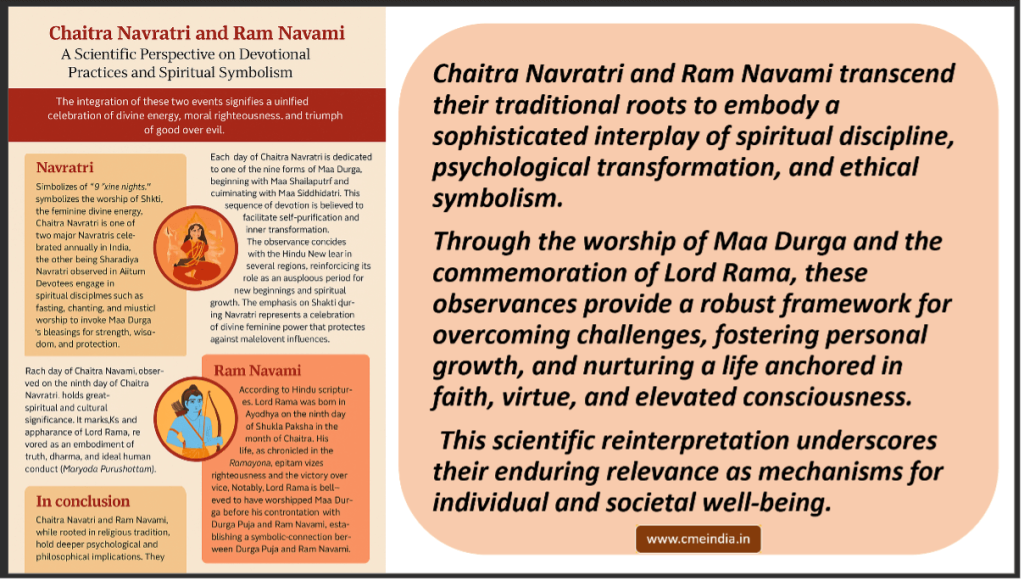
Chaitra Navratri and Ram Navami: A Scientific Perspective on Devotional Practices and Spiritual Symbolism
The confluence of Chaitra Navratri and Ram Navami represents a synthesized observance that integrates the veneration of divine energy, ethical integrity, and the archetypal triumph of virtue over malevolence. This dual celebration, deeply embedded in Hindu tradition, provides a multidimensional framework for exploring the interplay between spiritual practices, psychological transformation, and cultural symbolism.
Chaitra Navratri: The Celebration of Divine Feminine Energy
Chaitra Navratri, etymologically derived from “nava” (nine) and “ratri” (nights), is an annual Hindu festival dedicated to the worship of Shakti, the primordial feminine energy. Observed during the lunar month of Chaitra (March–April), it is one of two prominent Navratri celebrations in India, the other being Sharadiya Navratri in autumn. Practitioners engage in disciplined spiritual activities—including fasting, mantra recitation, and ritualistic worship—to invoke the blessings of Maa Durga, the goddess symbolizing strength, wisdom, and protective power.
The nine-day observance is systematically structured, with each day devoted to one of the nine manifestations of Maa Durga, commencing with Maa Shailaputri (the embodiment of foundational energy) and concluding with Maa Siddhidatri (the bestower of spiritual accomplishments). This sequential worship is hypothesized to facilitate a progressive process of self-purification and inner transformation, aligning with psychological models of incremental behavioral change and mindfulness.
Chaitra Navratri aligns with the Hindu New Year in various regions, amplifying its significance as a period of renewal and the initiation of auspicious endeavors. The reverence for Shakti underscores a symbolic acknowledgment of feminine potency as a counterforce to destructive influences, reflecting a culturally embedded appreciation for balance and resilience.
Ram Navami: The Manifestation of Ethical Ideals
Ram Navami, commemorated on the ninth day of Chaitra Navratri, celebrates the birth of Lord Rama, a central figure in Hinduism revered as the epitome of truth, righteousness (dharma), and exemplary human conduct (Maryada Purushottam). According to textual accounts in the Ramayana and other Hindu scriptures, Lord Rama was born in Ayodhya on the ninth day of the Shukla Paksha (waxing lunar phase) in Chaitra. His life narrative exemplifies the victory of moral order over chaos, most notably through his defeat of the demon king Ravana. A significant theological link emerges in the Ramayana, where Lord Rama is depicted as worshipping Maa Durga prior to his battle with Ravana, forging a symbolic and functional connection between the divine feminine power of Navratri and the ethical masculinity embodied in Ram Navami.
Synergistic Observance: A Holistic Spiritual Paradigm
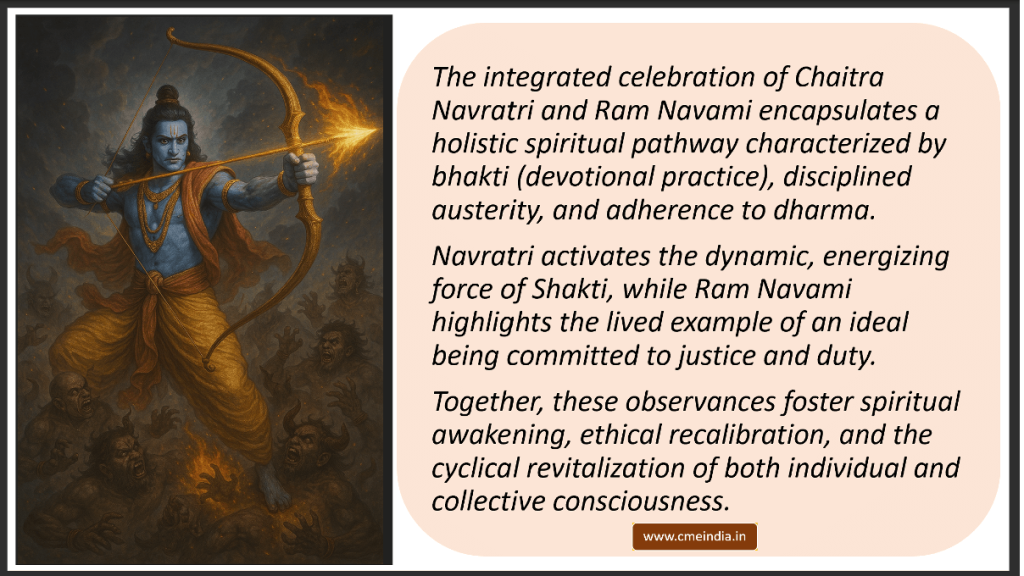
The integrated celebration of Chaitra Navratri and Ram Navami encapsulates a holistic spiritual pathway characterized by bhakti (devotional practice), disciplined austerity, and adherence to dharma. Navratri activates the dynamic, energizing force of Shakti, while Ram Navami highlights the lived example of an ideal being committed to justice and duty. Together, these observances foster spiritual awakening, ethical recalibration, and the cyclical revitalization of both individual and collective consciousness. This duality mirrors neuroscientific and psychological principles of reinforcement, where ritualistic repetition and symbolic narratives enhance cognitive-emotional resilience and moral clarity.
Psychological and Philosophical Implications
Beyond their religious context, Chaitra Navratri and Ram Navami offer a structured paradigm for psychological purification, intentional renewal, and the reinforcement of prosocial values. The veneration of Maa Durga empowers practitioners to confront internal and external adversities, potentially activating mechanisms akin to stress resilience and self-efficacy observed in cognitive-behavioral studies. Similarly, the emulation of Lord Rama’s virtues encourages the cultivation of ethical decision-making and interpersonal harmony, aligning with philosophical frameworks that prioritize duty and integrity.
CME INDIA Tail-Piece
“The sequential worship of Maa Durga’s nine forms is hypothesized to facilitate self-purification and inner transformation, a process supported by studies on meditation and attention regulation (Lutz et al., 2008).”
“The emulation of Lord Rama’s virtues encourages ethical decision-making, consistent with social cognitive theories of moral behavior (Bandura, 1991).”
“The empowerment derived from Durga’s worship aligns with resilience research, which emphasizes perceived control as a buffer against adversity (Southwick & Charney, 2012).”
References:
- Koenig, H. G. (2012). “Religion, Spirituality, and Health: The Research and Clinical Implications.” ISRN Psychiatry, 2012, 278730. DOI: 10.5402/2012/278730
- Lutz, A., Slagter, H. A., Dunne, J. D., & Davidson, R. J. (2008). “Attention Regulation and Monitoring in Meditation.” Trends in Cognitive Sciences, 12(4), 163–169. DOI: 10.1016/j.tics.2008.01.005
- Bandura, A. (1991). “Social Cognitive Theory of Moral Thought and Action.” In Handbook of Moral Behavior and Development (Vol. 1, pp. 45–103). Lawrence Erlbaum Associates.
- Haidt, J. (2001). “The Emotional Dog and Its Rational Tail: A Social Intuitionist Approach to Moral Judgment.” Psychological Review, 108(4), 814–834. DOI: 10.1037/0033-295X.108.4.814
- Southwick, S. M., & Charney, D. S. (2012). “The Science of Resilience: Implications for the Prevention and Treatment of Depression.” Science, 338(6103), 79–82. DOI: 10.1126/science.1222942
- Pargament, K. I., & Sweeney, P. J. (2011). “Building Spiritual Fitness in the Army: An Innovative Approach to a Vital Aspect of Human Development.” American Psychologist, 66(1), 58–64. DOI: 10.1037/a0021657
- Kandel, E. R. (2001). “The Molecular Biology of Memory Storage: A Dialogue Between Genes and Synapses.” Science, 294(5544), 1030–1038. DOI: 10.1126/science.1067020
Discover CME INDIA

- Explore CME INDIA Repository
- Examine CME INDIA Case Study
- Read History Today in Medicine
- Register for Future CMEs