
CME INDIA Presentation by CME INDIA Team.
CME India Perspective

As we transition into 2026, reflecting on the major scientific developments of 2025 offers a practical roadmap for evidence-based internal medicine. CME India, as India’s leading academic platform for physicians, has played a pivotal role in translating global evidence into bedside-relevant knowledge through webinars, clinical pearls, case discussions, and regional academic forums.
The year 2025 witnessed transformative progress across diabetes, thyroid disorders, cardiovascular medicine, nephrology, infectious disease, transplant science, and precision therapies — areas of particular relevance to Indian practice, given the high burden of metabolic disease, diverse infectious threats, and resource variability. Advances extended beyond glycaemic targets to include disease-modifying therapies, novel antibiotics, gene editing breakthroughs, and organ transplant milestones.
This review synthesizes the most impactful developments of 2025 and highlights their implications for everyday clinical practice in 2026, with an emphasis on pragmatic, personalized, and integrated care.
Diabetes Mellitus: From Glycaemia to Metabolic Reprogramming
Youth-Onset Type 2 Diabetes
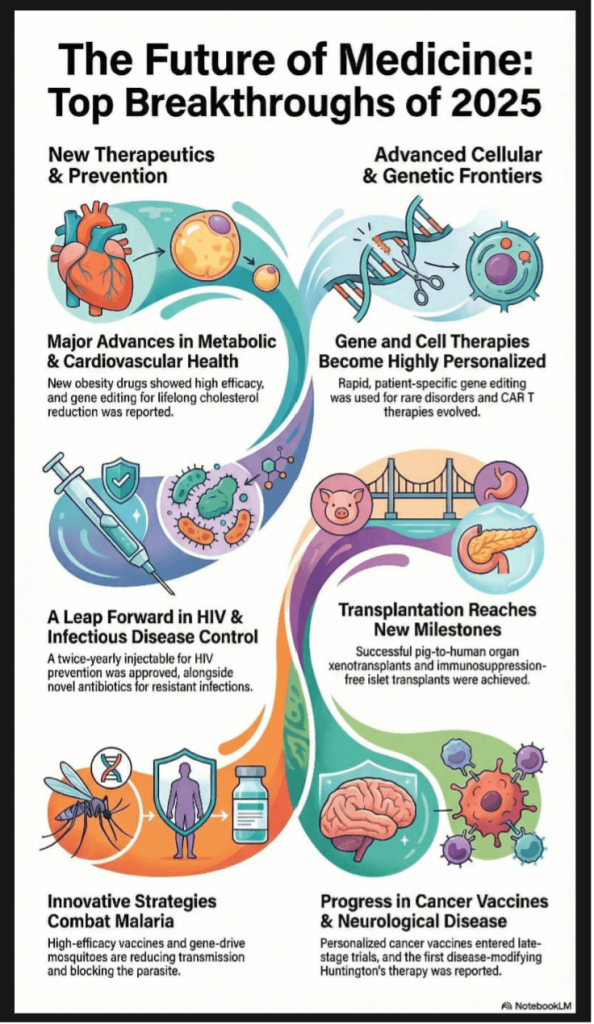
A major milestone in 2025 was the emergence of robust evidence for incretin-based multi-agonist therapy in adolescents with type 2 diabetes. Multi-agonists like tirzepatide demonstrated substantial HbA1c reduction and meaningful weight loss in youth with poor control, emphasizing early metabolic targeting in aggressive phenotypes seen frequently in India.
Continuous Glucose Monitoring (CGM)
CGM consolidated its role in type 2 diabetes, especially for insulin users. Its association with improved clinical outcomes underscores the importance of time-in-range optimization even in low-resource settings, where accuracy limitations are acknowledged and fingerstick confirmation remains important.
Inhaled Insulin
Ultra-rapid inhaled insulin gained recognition for controlling post-prandial glucose excursions. Its favorable profile for patients with high-carbohydrate meals or injection aversion provides a useful alternative in individualized care.
Metabolic Medicine Breakthroughs
2025 marked a watershed year for metabolic therapeutics with advancements in obesity and fatty liver disease treatments. New agents including GLP-1 + amylin receptor agonists, oral GLP-1 receptor agonists, and poly-agonist drugs expanded options beyond traditional pathways, while PCSK9 inhibition demonstrated cardiovascular risk reduction even in primary prevention settings. Lipoprotein(a) and triglyceride-directed therapies also moved closer to clinical reality. These innovations prompt clinicians to integrate metabolic targets long before end-organ damage manifests.
Infectious Diseases: Renewed Arms Race
Antibiotic Innovation
With global antibiotic resistance rising, 2025 delivered new antibiotics with novel mechanisms such as gepotidacin and zoliflodacin — crucial additions against resistant urinary and sexually transmitted pathogens. Discoveries in proteasome-derived peptides and AI-discovered broad-spectrum agents signal a revived pipeline for antimicrobial therapy.
HIV Prevention
Twice-yearly injectable agents like lenacapavir became globally approved, offering unprecedented protection against HIV and promising regimen adherence advantages, potentially transformable in high-burden regions.
Malaria Control
Phase 3 data emerged for highly effective malaria therapeutics and multistage vaccines, while innovative transmission-blocking strategies highlighted progress in global malaria elimination efforts.
Transplant Medicine: Breaking Immunological Barriers
Immune-Evasive Islet Cells
2025 saw the first transplant of gene-edited islet cells that function without lifelong immunosuppression — a harbinger of curative approaches for type 1 diabetes that could alter future standards of care.
Xenotransplantation
Advances
Pig-to-human kidney, liver, and lung transplants demonstrated scientific feasibility, while extensive CRISPR edits in donor organs minimized hyperacute rejection — breakthroughs that may one day expand organ availability in regions with transplant scarcity.
Gene and Cell Therapies: Precision and Durability
Personalized Gene Editing
Patient-specific genetic editing yielded real-world correction of ultra-rare metabolic conditions, achieving milestones from prenatal diagnosis to functional recovery. Expanded use of base and prime editing in disorders like chronic granulomatous disease highlights the maturing field of genomic medicine.
Neurological Disorders
Disease-modifying gene therapy slowed progression in Huntington’s disease for the first time, while induced pluripotent stem cell-derived neuron transplants showed promise in Parkinson’s. Additionally, vaccine and repurposing strategies hinted at novel dementia prevention paths.
CAR-Based Cell Therapy
In vivo CAR T-cell strategies — generating engineered immune cells directly within patients — and CAR NK cells for autoimmune conditions highlighted the next wave of adoptive cell therapies with broader applicability beyond oncology.
Thyroid Disorders: Precision Medicine and Policy Advances
Thyroid care in 2025 extended into molecular diagnostics and personalized hormone dosing.
Guidelines emphasized refined nodule evaluation and predictive biomarkers, while AI-augmented tools supported earlier, more accurate disease characterization.
Cardiovascular Risk: Integrated Metabolic and Preventive Strategies
The year’s evidence reinforced statins and novel lipid-lowering interventions in diabetes across risk categories. Advances in AI-guided diagnostics and minimally invasive interventions promise improved chronic risk management, while lifestyle interactions and vascular biology discoveries refine preventive cardiology.
Nephrology: Layered Protection and Microbiome Insights
Layered therapeutic strategies, building on RAS blockade, SGLT2 inhibition, and mineralocorticoid antagonism, gained stronger evidence in slowing kidney disease progression in diabetes. Microbiome research linked gut ecology to renal outcomes, reinforcing the importance of metabolic-renal interconnections in holistic care.
Emerging Technologies and Systems Medicine
AI-powered diagnostics, precision immunology, and integrated omics reshaped multiple specialties. The 2025 Nobel Prize in Physiology or Medicine honored discoveries in immune tolerance, with implications for autoimmunity, transplant science, and cancer immunotherapy.
Conclusion
The scientific advances of 2025 equip clinicians with tools that extend beyond symptom control toward disease modification, organ protection, and personalized care. CME India’s role in contextualizing these developments ensures their relevance to Indian clinical realities. As we embrace 2026, the integration of genomic medicine, novel antimicrobial strategies, metabolic therapies, and precision diagnostics will define the next era of internal medicine — with a sustained focus on affordability, access, and equity.
References:
- 10 Breakthroughs in Medicine in 2025 — Samuel Hume, Breaking Ground Substack
- ADA 2025 Standards of Care in Diabetes
- Major obesity and cardiometabolic therapeutic trials (2025)
- New antibiotic approvals and resistance science
- Gene editing & transplant advances
- Precision diagnostics & AI in medicine
- Nobel Prize in Physiology or Medicine 2025
Discover CME INDIA

- Explore CME INDIA Repository
- Examine CME INDIA Case Study
- Read History Today in Medicine
- Register for Future CMEs