
CME INDIA Case Presentation by Dr. Vaibhav Agnihotri, MBBS DCH, DNB, Paediatrician, Fellowship neonatology, Fellow in allergy asthma and immunology, PGPN Boston USA, PCBD John Hopkins USA.
Extreme Hyperbilirubinemia in a Child with Hepatitis A – A Rare Pediatric Presentation
CME INDIA Case Study
Quick Take Away
- We present a rare and unique case of an 11-year-old male child from Salasar, Rajasthan, who exhibited one of the highest documented levels of serum bilirubin (65 mg/dL) in pediatric literature associated with Hepatitis A infection.
- The case posed significant diagnostic and therapeutic challenges and required a multidisciplinary approach. Prompt recognition, supportive care, and vigilant monitoring led to a successful outcome.
How Presented?
- An 11-year-old male child presented with the following complaints:
- Severe abdominal pain
- Repeated non-bilious vomiting, including one episode of blood-tinged vomitus
- Refusal of oral intake
- Fatigue and lethargy
- Headache
- Glasgow Coma Scale (GCS) score: 13/15
Past History
- There was no significant prior comorbidity. The child had been admitted and managed symptomatically at multiple hospitals before being referred to our tertiary care center.
Examination Findings:
- Icterus: Profound
- Abdomen: Tenderness present; hepatomegaly and splenomegaly noted
- Neurological Status: Mildly altered sensorium (GCS 13/15)
Investigations:
| Ultrasound Abdomen: Ascites, hepatomegaly, splenomegaly |
| Serum Bilirubin: 65 mg/dL (one of the highest reported in a pediatric Hepatitis A case) |
| Liver Enzymes: Elevated transaminases sgot 5000, sgpt 6500 |
| Viral Markers: Hepatitis A IgM positive |
| Coagulation Profile & Electrolytes: Monitored closely and remained within compensable ranges |
Diagnosis:
- Acute Hepatitis A with severe hyperbilirubinemia
Management:
| A multidisciplinary pediatric team initiated intensive supportive management: |
| • Intravenous fluids and electrolyte correction |
| • Nutritional support |
| • Liver protective agents |
| • Monitoring of hepatic encephalopathy signs |
| • Serial LFTs and coagulation profiles |
| No plasma exchange or liver transplant was required. |
Outcome:
- The child responded positively to the treatment.
- Bilirubin levels gradually declined, and clinical parameters improved.
- The patient was discharged in good health with stable liver function and follow-up scheduled.
Discussion:
- This case underscores the variability in Hepatitis A presentations and highlights that even extreme hyperbilirubinemia can be managed successfully with early diagnosis and supportive care, without the need for invasive interventions.
- It adds to the growing evidence that severe cases in children, though rare, require high clinical suspicion and team-based management.
Conclusion:
- This case represents one of the highest serum bilirubin levels documented in pediatric Hepatitis A and reinforces the importance of timely referral and coordinated care in saving lives.
CME INDIA Learning Points
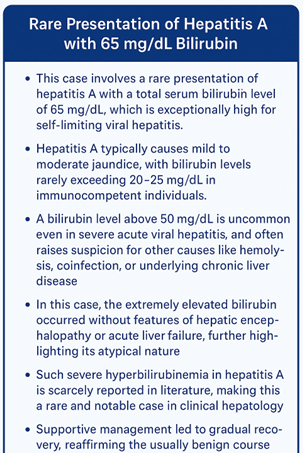
- This case involves a rare presentation of Hepatitis A with a total serum bilirubin level of 65 mg/dL, which is exceptionally high for a self-limiting viral hepatitis.
- Hepatitis A typically causes mild to moderate jaundice, with bilirubin levels rarely exceeding 20–25 mg/dL in immunocompetent individuals.
- A bilirubin level above 50 mg/dL is uncommon even in severe acute viral hepatitis, and often raises suspicion for other causes like hemolysis, co-infection, or underlying chronic liver disease.
- In this case, the extremely elevated bilirubin occurred without features of hepatic encephalopathy or acute liver failure, further highlighting its atypical nature.
- Such severe hyperbilirubinemia in Hepatitis A is scarcely reported in literature, making this a rare and notable case in clinical hepatology.
- Supportive management led to gradual recovery, reaffirming the usually benign course of Hepatitis A even in cases with extreme biochemical derangement.
CME INDIA Tail-Piece
- Hepatitis A, historically a childhood infection in India, has seen a notable epidemiological shift, now affecting adolescents and adults more frequently. These older age groups are at increased risk of complications, often necessitating hospitalization.
- This transition is largely attributed to improved socioeconomic conditions, sanitation, and access to clean water, which have reduced early childhood exposure to the virus.
- Recent studies have reported a decline in anti-HAV seroprevalence among adolescents and young adults, with rates as low as 55% in Indian children aged 5–15 years. Consequently, hepatitis A now accounts for a greater proportion of acute viral hepatitis cases in individuals over 15 years of age.
- The highest attack rate (4.6%) is observed in the 15–24 years age group, followed by 3.1% in children aged 5–14 years and 1.2% in those under five. Although the attack rate in adults over 25 years is under 1%, the large economically productive age group between 15 and 59 years makes the overall impact on public health and productivity substantial.
- Recurrent outbreaks in India are commonly reported among adolescents and adults, with contaminated food and water identified as primary sources.
- These findings underscore the urgent need for improved food safety and targeted vaccination of high-risk groups, especially food handlers. Recognizing the shifting disease burden, the Indian government has initiated prevention strategies, including vaccination campaigns.
| Hepatitis A is still endemic in India, though improving sanitation has shifted its epidemiology from early childhood infections to adolescent and adult presentations. |
| Infection is usually self-limiting, but adults are more likely to experience symptomatic disease, including jaundice and fatigue. |
| Diagnosis is confirmed by detecting anti-HAV IgM antibodies, which typically appear early in the symptomatic phase. |
| Most patients recover completely without antiviral therapy; supportive care and hydration are the mainstay of treatment. |
| Rare complications include fulminant hepatic failure, especially in older adults or those with pre-existing liver disease. |
| Hepatitis A is vaccine-preventable, and vaccination is recommended for children, travelers, and individuals with chronic liver disease. |
| Outbreaks still occur in India, particularly in areas with poor water quality or during monsoon seasons due to fecal contamination. |
| Hand hygiene, safe drinking water, and improved sanitation remain key to preventing transmission. |
| Co-infection with Hepatitis E is possible and can worsen outcomes, particularly in pregnant women. |
| Routine screening for HAV immunity in adults is not commonly done, but may be considered in healthcare or food industry workers. |
Acknowledgments:
Author sincerely thanks the medical and nursing team at [Soni Hospital/Jaipur] and the child’s family for their trust and cooperation
References:
- Murlidharan S, Sangle AL, Engade M, Kale AB. The Clinical Profile of Children With Hepatitis A Infection: An Observational Hospital-Based Study. Cureus. 2022 Aug 23;14(8):e28290. doi: 10.7759/cureus.28290. PMID: 36168369; PMCID: PMC9506446.
- https://www.cdc.gov/hepatitis/php/npr-2025/index.html
- Shenoy B, Andani A, Kolhapure S, Agrawal A, Mazumdar J. Endemicity change of hepatitis A infection necessitates vaccination in food handlers: An Indian perspective. Hum Vaccin Immunother. 2022 Dec 31;18(1):1868820. doi: 10.1080/21645515.2020.1868820. Epub 2021 Feb 17. PMID: 33595412; PMCID: PMC8920195.
Discover CME INDIA:

- Explore CME INDIA Repository
- Examine CME INDIA Case Study
- Read History Today in Medicine
- Register for Future CMEs
Any evidence of sickle cell disease in this case/or was it ruled out
What if he was having compromised liver function test aur having gilbert or any other genetic condition.
That could have added to such high bilirubin levels .