

CME INDIA Case Presentation by Dr. Prabhat Agarwal, Professor of Medicine, Agra.
CME INDIA Case Study
Dapagliflozin and the Haemoglobin That Rose Too Fast — SGLT2 Inhibitor–Associated Erythrocytosis
The Case
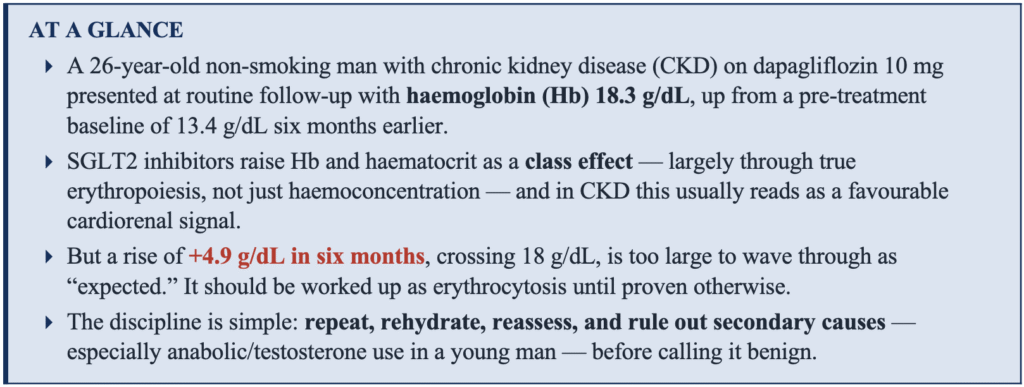
A 26-year-old man with established CKD, on dapagliflozin 10 mg once daily, attended a routine follow-up. He was asymptomatic and a lifelong non-smoker. A surveillance complete blood count returned a haemoglobin of 18.3 g/dL (laboratory reference 12.0–16.0 g/dL). Six months earlier, immediately before dapagliflozin was started, his haemoglobin had been 13.4 g/dL — comfortably within range. The concurrent renal and biochemical panel is shown in Table 1.
Table 1. Laboratory panel at presentation
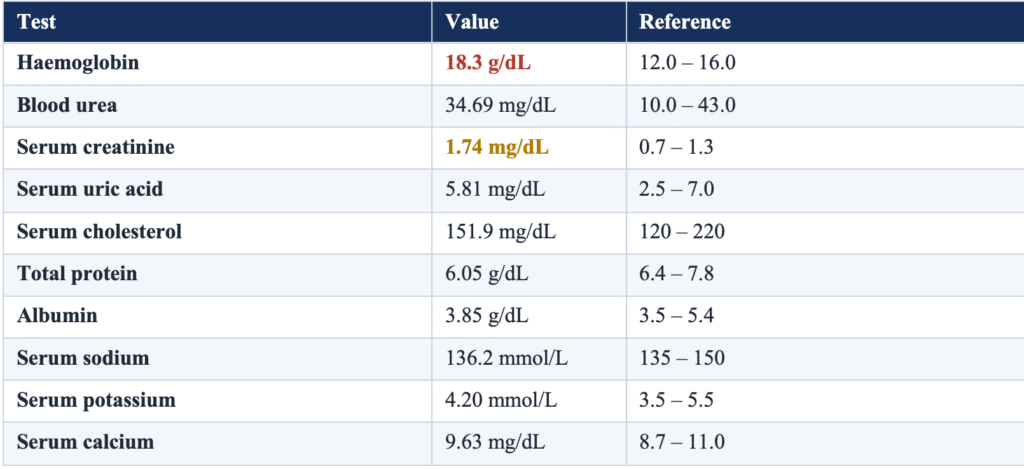
Mildly elevated creatinine is consistent with the known CKD; the standout is the isolated, marked rise in haemoglobin.
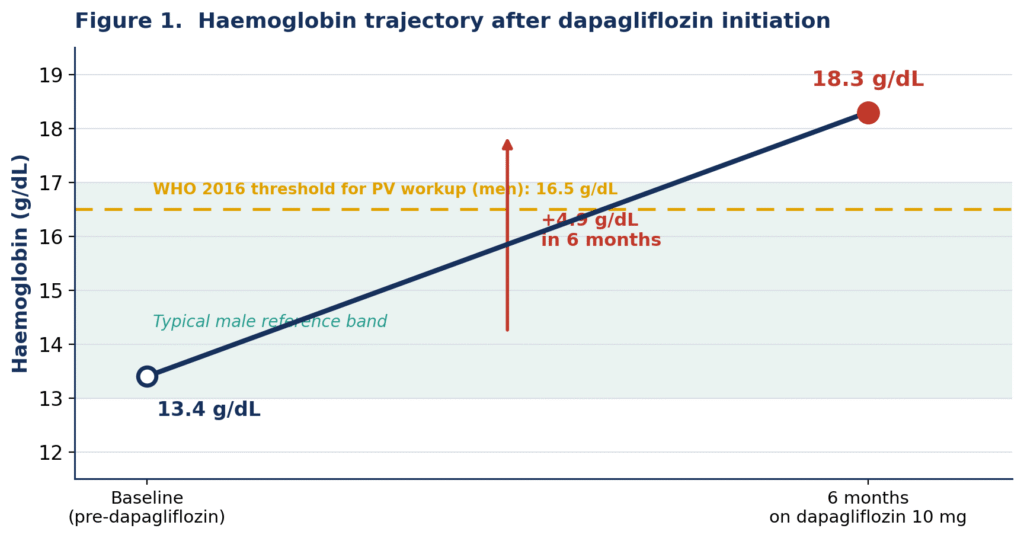
Figure 1. The six-month haemoglobin trajectory. The current value sits above the WHO 2016 threshold that prompts a polycythaemia work-up in men.
The Core Message: A Class Effect, Not a Lab Error
The first instinct — “check the sample, it must be an error” — is usually wrong here. A rise in haemoglobin and haematocrit on an SGLT2 inhibitor is now a well-recognised, reproducible class effect, seen with dapagliflozin, empagliflozin, canagliflozin and ertugliflozin, and it is not merely dehydration.
Early volume contraction from glucosuria and natriuresis does contribute in the first weeks, but the sustained component reflects genuine erythropoiesis. After dapagliflozin is started, serum erythropoietin rises and plateaus over 2–4 weeks, reticulocytes climb, and haemoglobin and haematocrit follow [1]. Three threads drive this (Figure 2): relief of proximal-tubular workload and cortical hypoxia restores erythropoietin-producing fibroblasts; anti-inflammatory suppression of hepcidin frees up iron for the marrow; and a modest early haemoconcentration adds a transient top-up [1,2].
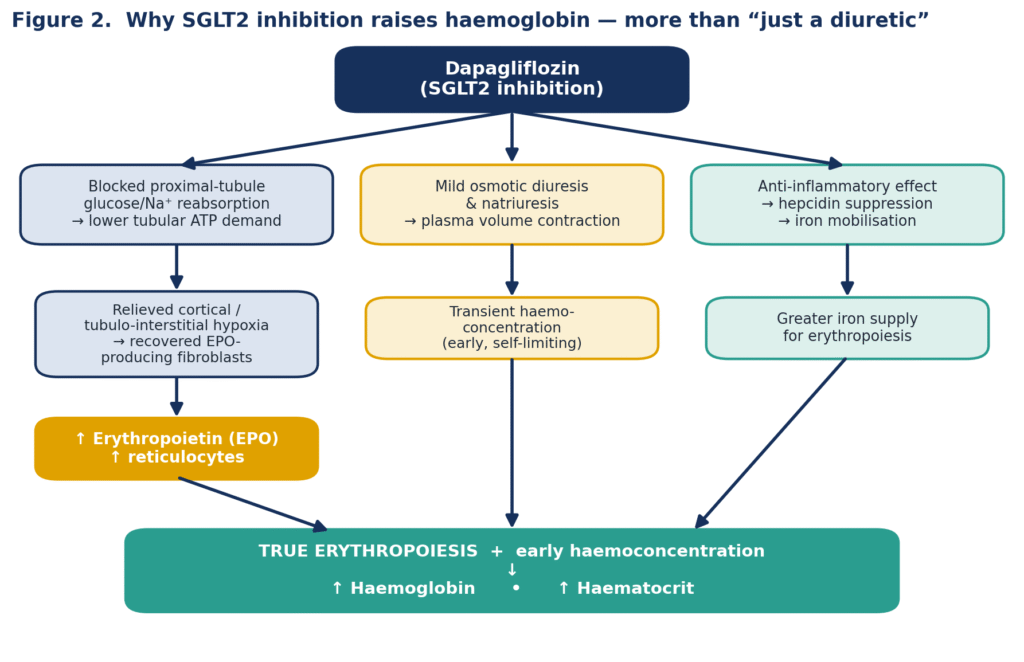
Figure 2. Why SGLT2 inhibition raises haemoglobin — a convergence of restored erythropoietin signalling, better iron availability, and early volume shifts.
Crucially, in CKD this is usually a good-news signal. In the DAPA-CKD trial, dapagliflozin raised haematocrit by about 2.3 percentage points versus placebo and corrected or prevented anaemia — anaemia resolved in roughly 53% on dapagliflozin versus 29% on placebo (hazard ratio ≈ 2.3), with or without diabetes [3]. A 2026 systematic review reached the same conclusion and linked the haematological gain to lower mortality [4]. So the question is not whether dapagliflozin can raise haemoglobin. It can. The real question is different.
Why This Particular Rise Deserves a Second Look
The class effect is modest — typically a 2–4% rise in haematocrit, a physiologically regulated response with a homeostatic ceiling. A jump from 13.4 to 18.3 g/dL (+4.9 g/dL) in six months is not modest. It crosses the WHO 2016 haemoglobin threshold for men (>16.5 g/dL) that conventionally triggers a polycythaemia work-up [5]. A move of this magnitude should be treated as erythrocytosis until proven otherwise — an expected direction of travel does not license an unexpected distance.
| Bedside principle: Drug-induced erythrocytosis is a diagnosis of probability — not permission to stop thinking. |
Is Dapagliflozin the Whole Story?
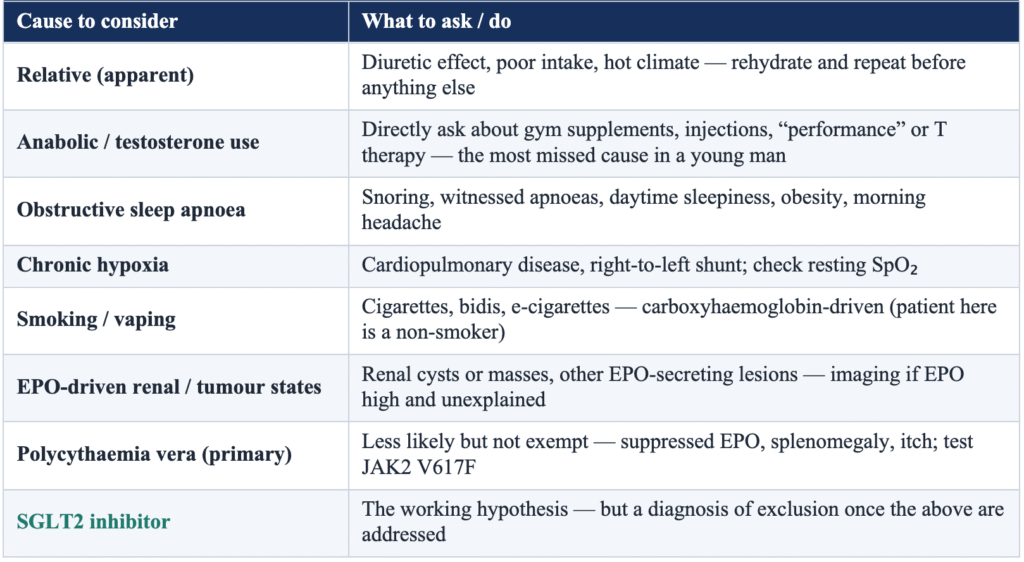
Dapagliflozin is a very plausible contributor here. But the size of the rise means one of three things is happening: (a) an amplified drug effect, (b) superimposed volume contraction inflating the number, or (c) a second, independent cause of erythrocytosis riding alongside the drug. The safest stance is to assume more than one process may be at work and screen accordingly (Table 2).
Table 2. Secondary erythrocytosis — what to actively screen for
A Practical Approach: Repeat, Rehydrate, Reassess, Rule Out
The first practical step is the cheapest: ensure good hydration and repeat the CBC with haematocrit. A dry patient can look hematologically dramatic for no good reason, and relative (apparent) erythrocytosis is excluded here, not assumed. If the value normalises, the story ends. If it persists, think beyond the drug and follow a structured pathway (Figure 3).
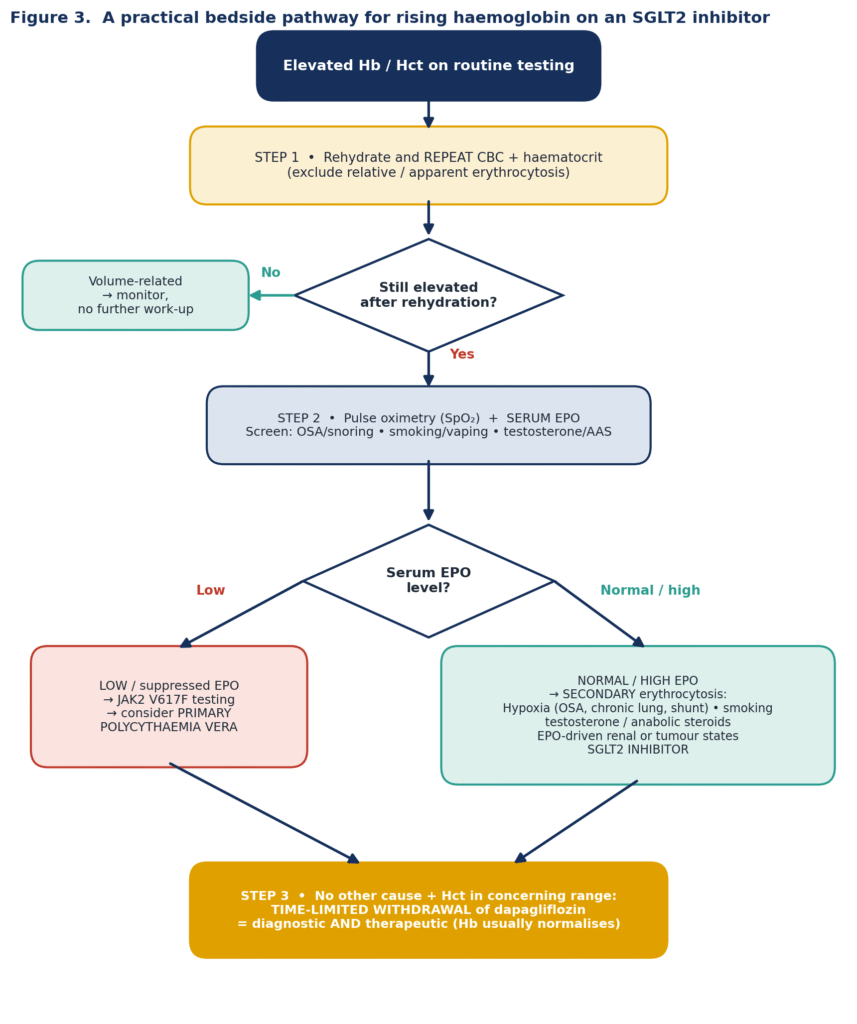
Figure 3. Confirm true erythrocytosis first, then let serum EPO split the differential; a time-limited drug challenge is both diagnostic and therapeutic.
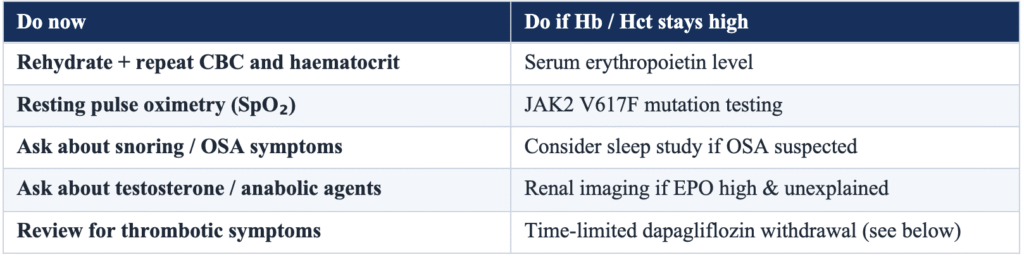
Two first-line tests do most of the work: resting pulse oximetry and serum erythropoietin. A low or suppressed EPO points toward polycythaemia vera and warrants JAK2 V617F testing; a normal-to-high EPO points toward a secondary, EPO-driven process — which is where hypoxia, anabolic steroids and, indeed, the SGLT2 inhibitor sit [5,6]. Table 3 lists the pragmatic work-up for this patient.
Table 3. Suggested work-up for this patient
The Special Trap in a 26-Year-Old Man
Age reshapes the differential. In a young man, one must specifically and non-judgementally ask about gym hormones, testosterone and anabolic agents — a use pattern that is increasingly common among fitness-focused young adults in urban India and one of the most frequently missed causes of secondary erythrocytosis. Exogenous androgens drive erythropoiesis directly; the classic picture is a rising haematocrit with an inappropriately normal or high EPO and negative JAK2 [6,7]. It is easy to anchor on the prescription in the chart and never ask about the vial in the gym bag.
What About Clot Risk?
The reassuring news is that SGLT2-associated rises in haematocrit have not consistently translated into excess thrombotic events in trial populations, and the effect appears physiologically regulated rather than runaway. Secondary erythrocytosis in general also carries a lower thrombotic risk than polycythaemia vera [6]. That said, caution is warranted at the extremes — a value near 18 g/dL, or a haematocrit crossing the mid-50s, in a patient with additional risk factors is not a number to observe passively.
When — and How — to Challenge the Drug
If no alternative cause emerges and the haemoglobin/haematocrit stays persistently high or reaches a concerning range, a time-limited withdrawal of dapagliflozin is the elegant next move: it is both diagnostic and therapeutic. Published CKD case reports confirm that dapagliflozin-related erythrocytosis is real, can appear rapidly, and that haemoglobin often falls back after the drug is stopped [8]. A normalisation on withdrawal effectively closes the loop. Any decision to pause an agent with proven cardiorenal benefit must, of course, weigh what is being given up — which is precisely why secondary causes are excluded first.
Bottom Line
| In this patient, the rise in haemoglobin is very likely related to dapagliflozin — but it is too marked to ignore. The right approach is not to explain it away or to reflexively stop a beneficial drug, but to repeat, rehydrate, reassess and rule out secondary causes — hydration, oximetry, EPO, JAK2, and a candid conversation about anabolic use — before labelling it benign. |
Key Learning Points
- SGLT2 inhibitors raise Hb/Hct as a class effect driven by real erythropoiesis (EPO, iron, renal oxygenation), not dehydration alone.
- In CKD this is usually beneficial — dapagliflozin corrects and prevents anaemia (DAPA-CKD).
- The expected effect is modest (2–4% Hct). A jump to 18.3 g/dL (+4.9 in 6 months) is not — treat it as erythrocytosis until proven otherwise.
- First move is free: rehydrate and repeat. Then let SpO₂ + serum EPO (± JAK2) split the differential.
- In a young man, always ask about testosterone / anabolic agents — the commonly missed cause.
- If unexplained or extreme, a time-limited dapagliflozin withdrawal is both diagnostic and therapeutic.
| “Dapagliflozin can raise haemoglobin — but when it rises too much, the diagnosis should not stop at the prescription.” |
References:
1. Sano M, Goto S. Possible mechanism of hematocrit elevation by sodium glucose cotransporter 2 inhibitors and associated beneficial renal and cardiovascular effects. Circulation. 2019;139(17):1985–1987.
2. Ghanim H, Abuaysheh S, Hejna J, et al. Dapagliflozin suppresses hepcidin and increases erythropoiesis. J Clin Endocrinol Metab. 2020;105(4):dgaa057.
3. Koshino A, Schechter M, Chertow GM, et al. Dapagliflozin and anemia in patients with chronic kidney disease (DAPA-CKD). NEJM Evid. 2023;2(6):EVIDoa2300049.
4. Dapagliflozin improves hemoglobin and anemia in chronic kidney disease: a systematic review and meta-analysis. Ren Fail. 2026;48(1) (doi:10.1080/0886022X.2026.2636407).
5. Tefferi A, Barbui T. JAK2-unmutated erythrocytosis: current diagnostic approach and therapeutic views. Am J Hematol. 2023;98(8):1310–1320 (doi:10.1002/ajh.26920).
6. Differential diagnosis of erythrocytosis and analysis of clinical utility. Front Med (Lausanne). 2025;12:1742762.
7. Testosterone use causing erythrocytosis. CMAJ. 2017;189(41):E1286–E1288.
8. Dapagliflozin-induced erythrocytosis in chronic kidney disease: a rare occurrence. Cureus. 2024 (PMC11112539).
Prepared for CME India (www.cmeindia.in). Educational case review; not a substitute for individualised clinical judgement. Reference details should be verified against source records before formal publication.
Discover CME INDIA:

- Explore CME INDIA Repository
- Examine CME INDIA Case Study
- Read History Today in Medicine
- Register for Future CMEs