

CME INDIA Presentation by Nagendra Kumar Singh ( N.K.Singh)1*, Akashkumar N Singh2, Bijay Patni3, Ajoy Tewari4 and Sanjeev Phatak5.
1 Diabetes and Heart Research Centre, Near Dhanbad Guest House, Shramik Chauk, Rangatand, Dhanbad, Jharkhand 826001, India. 2 Manjalpur Hospital Pvt Ltd, Manjalpur, Vadodara, India. 3 DRWA , Diabetes Wellness Care, Kolkata,India. 4 Jai Clinic and Diabetes Care Centre, Lucknow, India. 5 Vijayratna Diabetes Centre, Sumeru Centre, Paldi, Ahmedabad, India.
Unlocking New Potential.
First of its kind Study
- On September 3rd, 2024, BMC, a high-impact journal from the Nature Springer group, published a study titled, “Leveraging the Use of a Social Media App as a Collaborative Medical Information and Knowledge Sharing Tool – Insights from Experiential Use and Survey of a CME WhatsApp Community.”
- This article chronicles the remarkable journey of CME INDIA since its inception in 2016.
- Founded by Dr N.K. Singh, the CME INDIA group began as an initiative to use WhatsApp as an educational tool with 250 members.
- Today, it serves the educational needs of over 7,000 physicians, earning a reputation as India’s most respected academic and scientific community. With round-the-clock support, it enhances clinical judgment and improves patient care. As the saying goes, CME INDIA never sleeps.
What was in Background?
- The widespread adoption of smartphones has significantly influenced how professionals access and share information via social media (SM), defined as platforms for digital networking and sharing user-generated content. Research on SM use in professional settings often focuses on public platforms like Facebook, X (formerly Twitter), and LinkedIn (LI). A US survey by Hameed et al. found that about 70% of physicians had a SM presence, though 90% posted infrequently. Female and younger physicians were more likely to be present on SM, while surgeons and older physicians had higher engagement levels.
- WhatsApp, a popular messaging platform available in 180 countries, had 2.78 billion active users as of June 2023, with the most users in India. It offers real-time content sharing and has gained traction among professionals, including the medical community, for case discussions, knowledge sharing, and collaboration. However, the high message volume and potential misinformation can disrupt communication, necessitating effective moderation and clear guidelines.
- Continuing medical education (CME) is crucial for physicians to stay updated, but access to quality content like conferences and webinars can be challenging, especially for those in remote areas or with busy schedules. A well-structured WhatsApp group could serve as a valuable CME tool if used interactively and not merely as a broadcast platform. This paper presents the experiences of one professional community using WhatsApp for CME and the results of a survey assessing its impact among 3,500 physicians.
How Research was Planned?
- The WhatsApp CME India is a cluster of seven WhatsApp groups comprising 3,500 registered medical professionals ( At the time of study), mainly from internal medicine and allied branches, with most members based in India, including rural areas, and Indian-origin NRI professionals.( Now CME INDIA has strength of 7000 physicians and 9 WhatsApp groups in September 2024)
- Founded seven years ago as a single group by a physician, the platform aims to facilitate the exchange of expertise in internal medicine through case discussions, expert opinions, and updates on publications and guidelines. Daily updates also include engaging topics like medical quizzes and history in medicine. The groups maintain a focused, professional environment, moderated by an administrator and a core team that guide discussions and manage cross-group dissemination of information.
- A prospective observational survey was conducted to assess the utility and value of this knowledge-sharing platform. A questionnaire developed by the study’s authors, with input from specialists and a statistician, was distributed via Google Forms within the groups between May and June 2023. The survey aimed to understand members’ engagement, attitudes, and the platform’s impact on enhancing knowledge. Questions focused on daily engagement, the platform’s comparative value, and its role as a CME tool. Participation was voluntary, with the survey link shared multiple times, and responses were analyzed using SPSS version 24.0, reported as descriptive statistics.
What was found?
- Out of 3,500 medical professionals in the WhatsApp CME India groups, 581 (16.6%) responded to the survey, with 25% of respondents from North America and the rest from India. All respondents accessed the group daily, with 43% doing so 1-4 times a day, and 32% accessing it more frequently.
- The WhatsApp CME India group was valued by 48% of participants as a key resource for challenging cases, on par with other resources like medical websites (57%), referral books (49%), and Google (43%). Group discussions on medical cases (77%) and insights from fellow physicians (70%) were highlighted as the most valuable aspects of the group, followed by summaries of recent publications and CME updates.
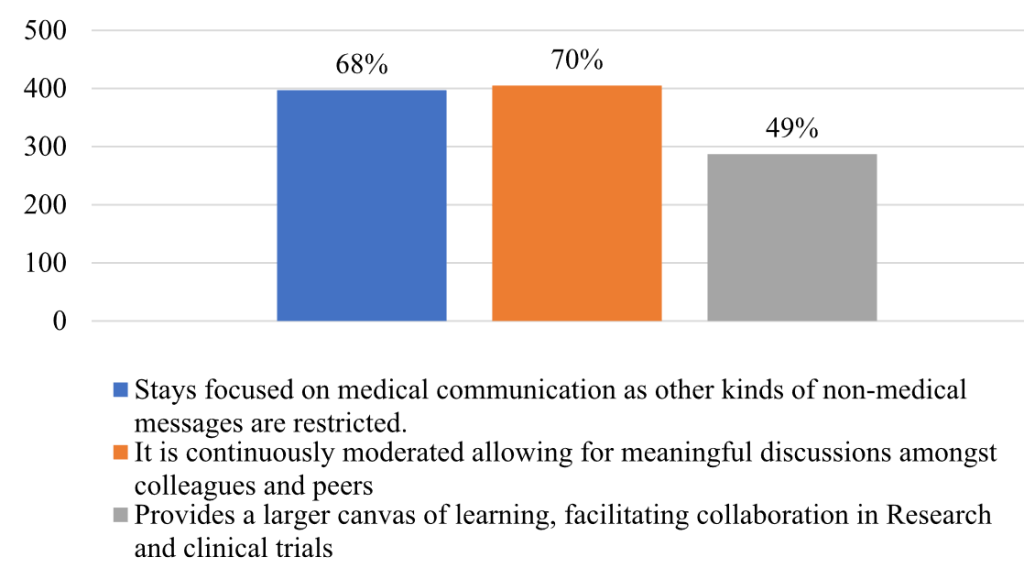
- Most Attractive quality of the WhatsApp CME India Group Functioning
Courtesy: Singh et al. BMC Medical Education (2024) 24:960
https://doi.org/10.1186/s12909-024-05941-x
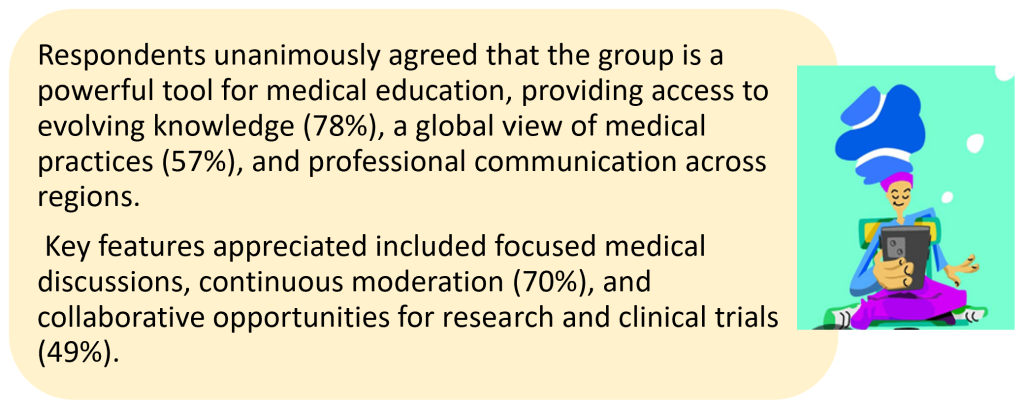
- Respondents unanimously agreed that the group is a powerful tool for medical education, providing access to evolving knowledge (78%), a global view of medical practices (57%), and professional communication across regions. Key features appreciated included focused medical discussions, continuous moderation (70%), and collaborative opportunities for research and clinical trials (49%).
- Activities of Most Academic value in the WhatsApp CME India Group

Courtesy: Singh et al. BMC Medical Education (2024) 24:960
https://doi.org/10.1186/s12909-024-05941-x
- While 94% of participants felt the group supplements but does not replace physical conferences, 81% appreciated post-conference summaries shared in the group. Case discussions (31%) and updates from fellow physicians (24%) were also noted as highly valuable academic activities.
What are Unique Messages from this original Study
- Social media use in education is growing, with platforms like Facebook and Twitter often used to extend the reach of traditional CME formats such as conferences and webinars. WhatsApp CME India is unique as a professional community using WhatsApp for daily knowledge sharing and learning for over seven years, growing from a single group to seven due to high demand.

- Survey results highlight WhatsApp’s potential as a powerful CME tool, thanks to its user-friendly interface, ease of use, and effective moderation. Key academic activities valued by members include case discussions, updates on guidelines, new therapies, and summaries of key publications. These activities blend seamlessly with traditional resources like medical websites and books, demonstrating professionals’ receptiveness to blended learning.
- The survey found a high engagement with case discussions (77%) and updates from colleagues (70%), showcasing a collaborative learning environment unique to WhatsApp’s real-time, democratic platform. However, the response rate was 16.6%, reflecting typical social media group dynamics where active participation is limited to a minority.
- Advantages of the platform include its geographical reach and real-time interaction, especially valuable during events like the COVID-19 pandemic. However, challenges such as information overload, group size limitations, difficulty in tracking responses, and the risk of misinformation pose significant hurdles. Effective use requires clear group guidelines, active moderation, and robust administrative oversight.
- The study acknowledges limitations, including the low response rate and potential gaps in understanding the platform’s drawbacks. Future research should explore these limitations, seek ways to enhance WhatsApp’s effectiveness as an educational tool, and address discipline-specific needs.
CME INDIA Take-Away
| The WhatsApp CME India group demonstrates the potential of social media for professional knowledge sharing in an integrative and interactive format. |
| Survey results highlight the platform’s role in facilitating peer-based learning through user-friendly features and real-time discussions. |
| Key challenges include managing information overload and preventing topic digression, which require active and diligent moderation. |
| Understanding the platform’s limitations and gathering feedback from members are essential steps to maximize its educational potential. |
| While promising, ongoing research and refinement are needed to enhance WhatsApp’s effectiveness as a tool for professional education. |
CME INDIA Tail-Piece
- Link to the open Access article: https://bmcmededuc.biomedcentral.com/counter/pdf/10.1186/s12909-024-05941-x.pdf
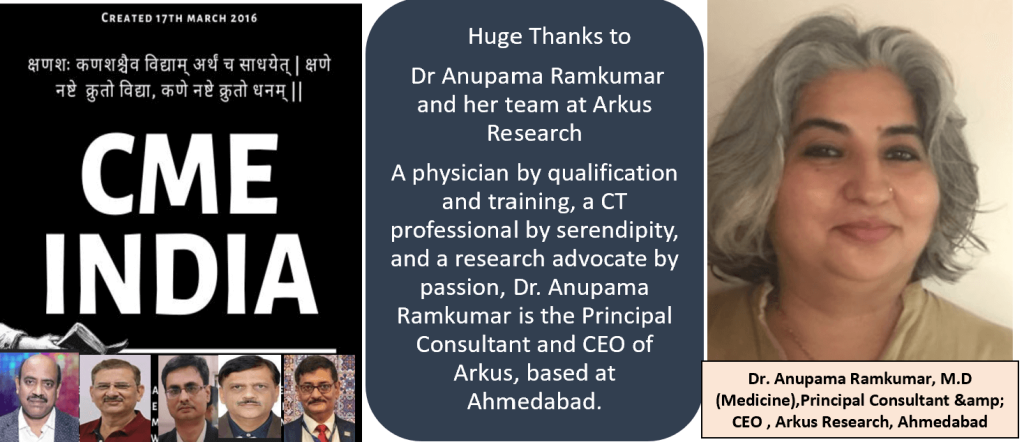
- Thanks to CME INDIA members who took part.
Reference:
- Nagendra Kumar Singh, Akashkumar N Singh, Bijay Patni, Ajoy Tewari and Sanjeev Phatak. “Leveraging the Use of a Social Media App as a Collaborative Medical Information and Knowledge Sharing Tool – Insights from Experiential Use and Survey of a CME WhatsApp Community. BMC Medical Education (2024) 24:960.https://doi.org/10.1186/s12909-024-05941-x
Discover CME INDIA

- Explore CME INDIA Repository
- Examine CME INDIA Case Study
- Read History Today in Medicine
- Register for Future CMEs
It is proven beyond doubt the utility of social media,
Thanks to Dr N K Singh for updates the Physician community on various topics of interest
Excellent
Very interesting and informative and directed accordingly to recent guidelines