
CME INDIA Presentation by Dr. Shambo Samrat Samajdar, MBBS MD DM (Clinical Pharmacology) PG Dip Endo & Diabetes (RCP, UK) Consultant, Diabetes & Allergy-Asthma Therapeutics Specialty Clinic, Kolkata; Dr. Shashank R. Joshi, Endocrinologist, Mumbai.
Hanumanashtak – A Prayer and a Paradigm for Healers
The Hanumanashtak (Sankat Mochan Hanuman Ashtakam) is an eight-verse devotional hymn composed by the poet-saint Tulsidas in praise of Lord Hanuman, concluding with a benedictory doha (couplet). Each verse recalls a heroic episode where Hanuman, the ardent devotee of Lord Rama, alleviates great suffering. In childhood he tried to swallow the sun, plunging the world into darkness until the gods pleaded and he released it, restoring light. He shielded his friend Sugriva from a tyrant’s wrath, enabling Lord Rama to deliver justice. He led the search for Sita, vowing not to return without finding her. He located Sita in captivity and comforted her despair, delivering to her Rama’s ring – a token of hope. He carried the physician Sushena and the life-giving herb Sanjeevani to revive Lakshman from a deathly wound. He freed Rama and Lakshman from sorcerous bonds and even descended to the netherworld to rescue them from a dark fate. Finally, in the closing verse, the devotee (Tulsidas) humbly implores Hanuman – Sankat Mochan, the Remover of Distress – to grace him and dispel all his troubles, calling Hanuman his Guru and ultimate refuge.
These legendary vignettes are more than religious lore; they are rich allegories imbued with philosophical and ethical insight. For a physician and healer in modern practice, the symbolism of the Hanumanashtak offers a compelling framework for personal and professional growth. Hanuman’s character synthesizes bhakti (devotion) and shakti (strength), humility and heroism, knowledge and service – qualities that resonate deeply with the ideals of medical practice. In this narrative review, we reflect on five key themes inspired by the Hanumanashtak: (1) Reverence and surrender to the Guru as a pillar of a physician’s growth, (2) The sacred accumulation and responsible use of knowledge and skill, (3) Balancing devotion (bhakti) and power (shakti) in practice, (4) The doctor–patient relationship as a form of holy service (seva), and (5) Truthfulness, humility, and the spiritual discipline of surrendering outcomes to the Supreme. Each section blends contemplative devotion with academic insight, drawing on Hanuman’s exploits for guidance on the healer’s path.
Reverence for the Guru: Surrendering to the Guiding Light
In the Indian spiritual and scholarly tradition, the Guru (teacher) is revered as an embodiment of the divine: “Acharya Devo Bhava” – the teacher is to be honored as God. Classical Ayurvedic texts hold teachers in the highest esteem; the ancient sages of medicine were even addressed by the honorific “Bhagavan,” a title reserved for deities. This reflects an understanding that the Guru’s wisdom is a sacred light passed down to dispel ignorance. Hanuman’s own story is intertwined with the guidance of teachers. As a restless young monkey he attempted to eat the sun, mistaking it for a fruit, until divine mentors intervened. Later, chastened and eager for true knowledge, Hanuman sought out Surya (the Sun God) as his Guru, humbly flying alongside the sun to imbibe the Vedic sciences. Through surrender and discipline, the very orb he once playfully seized as a child became his illumining teacher.
For a physician, reverence for one’s mentors and teachers is the bedrock of lifelong learning. Medical knowledge and the art of healing are traditionally passed in an apprenticeship model – from the attending who guides a junior doctor through their first surgery, to the senior nurse who teaches compassionate bedside manners. Surrendering to the Guru means approaching this learning with respect, trust, and ego-less devotion. Just as Hanuman exemplified the ideal disciple – absorbing wisdom with humility and implementing it in service of Lord Rama – a physician allows the teachings of gurus (medical professors, clinical mentors, even patients as teachers) to shape his or her growth. When Tulsidas in the Hanumanashtak’s final verse pleads, “O Lord, I ask you to remove any obstacle as you are my guru”, it highlights that even the most capable healer remains a lifelong student, forever guided by a higher wisdom. By surrendering pride at the guru’s feet, the physician gains access to a lineage of knowledge greater than any individual.
Indeed, the Hippocratic tradition also frames medicine as a sacred trust handed down from teacher to pupil. Physicians swear to “honor and respect” their mentors and to share the art only with those duly trained – an echo of the guru-shishya (teacher-disciple) covenant. Modern medical education, though technology-driven, still relies on mentorship and role-modelling. The reverence and gratitude we show our teachers cultivates shraddha (faithful devotion) – an attitude that opens our minds to deeper understanding. It is said that Hanuman’s power flowed from utter devotion to Lord Rama; analogously, a physician’s true efficacy often flows from devotion to their guiding ideals and mentors. The guru’s blessings bestow not just technical knowledge but also the sanskars (impressions) of ethical, compassionate practice. Surrender to the Guru is therefore not subservience, but a conscious alignment with the highest standards of the healing vocation. In that surrender, the physician’s ego is tamed, making space for continual learning and divine insight to enter. Just as Hanuman bowed to his Guru and thereby obtained the brilliance to remove darkness, a healer grounded in guru-bhakti develops the clarity to illuminate the lives of others.
Knowledge as a Sacred Trust: The Light that Dispels Darkness
Modern medicine prizes the accumulation of knowledge and technical skill. Physicians spend years mastering anatomy, pharmacology, surgical technique – amassing a “sun” of radiance in intellectual brilliance. Yet the Hanumanashtakreminds us that knowledge is truly sacred only when used responsibly as a light to dispel suffering. In the first verse, the young Hanuman caused an eclipse by devouring the sun, plunging “three worlds” into darkness out of innocent exuberance. This cosmic misadventure was a lesson: even great power (scientific or otherwise) can cast shadows if wielded without wisdom. Only when Hanuman released the sun at the pleading of others did balance return, earning him the title “Sankat Mochan” – Remover of Distress – one who removes ignorance (darkness) by his light (knowledge). The physician too must “release the sun” – sharing and applying knowledge for the benefit of all – rather than hoarding expertise for personal pride or letting it scorch others with arrogance. Knowledge in medicine is a sacred trust, not an egoistic possession.
In ancient Ayurveda, medical knowledge was considered so hallowed that it came with a code of moral conduct. The Charaka Samhita, an Ayurvedic canon, declares that an ideal physician should be “healthy, modest, patient, truthful, skillful, and fearless… and not be boastful of his knowledge”. This striking admonition – not boastful of knowledge – underscores that expertise must be married to humility. A doctor may hold a vast repository of facts and cutting-edge skills, but the moment this turns into vanity or a sense of infallibility, it eclipses the very light of healing. The Hanuman archetype teaches us that knowledge finds its highest purpose in service of the divine and the vulnerable, not in self-aggrandizement. After all, Hanuman’s every exploit was fueled by devotion to Rama and compassion for others – he utilized his prodigious abilities only to serve a just cause or save a life, never to flaunt them.
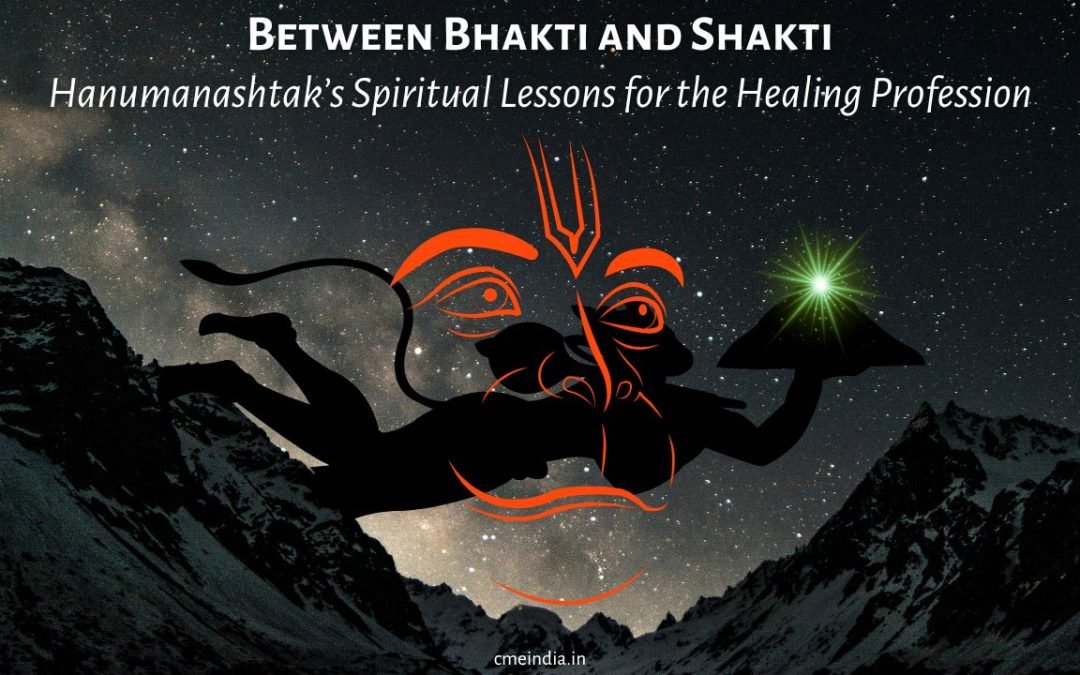
There is also a profound responsibility that accompanies knowledge. Just as the gods entrusted Hanuman with critical missions (finding Sita, carrying the healing herb, etc.), society entrusts physicians with intimate knowledge of the human body and life. In the Hippocratic oath’s spirit, doctors vow to use this knowledge ethically and for the patient’s benefit, abstaining from harm. Medicine thus becomes what has been called a “sacred vocation,” where specialized knowledge and the power to heal are seen as gifts from the divine, entrusted to humans to safeguard life. The physician is “called” to exercise this sacred knowledge with reverence, gratitude, and a deep sense of duty. In practical terms, this means rigorous adherence to truth and evidence, commitment to ongoing learning, and the courage to acknowledge the limits of one’s knowledge. Hanuman’s quest for the Sanjeevaniherb in verse 5 illustrates this responsible scholarship: when Lakshman lay mortally wounded, Hanuman flew to the Himalayas to obtain the remedy. Uncertain which plant was the cure, he lifted the entire Dronagiri mountain to ensure no life-saving herb was left behind. This image of carrying a mountain for one patient’s life is a vivid metaphor for the lengths a healer should go in applying knowledge. It is the antidote to complacency. We too must sometimes comb through mountains of medical literature, or consult colleagues (as Hanuman consulted Sushena, the physician) to find the sanjeevani for our patients.
In essence, medical knowledge is a light of consciousness – a reflection of the divine illumination of truth. The Hanumanashtak enjoins the healer to use that light to conquer the darkness of disease and ignorance. It calls us to be scholar-servants: accumulating vast knowledge, yet ever mindful that its true purpose is Lokasangraha – the well-being of the world. A physician who holds knowledge with the humility of Hanuman (who never claimed credit for his miracles) becomes a true “Sankat Mochan” for patients, channeling wisdom to remove the gloom of illness and fear.
Bhakti and Shakti in Healing: The Power of Devotion and the Discipline of Skill
Hanuman is the very personification of the synergy between bhakti (devotional love) and shakti (powerful capability). Physically, he is famed as Mahavira – possessing immeasurable strength, courage, and even magical powers. Spiritually, he is the epitome of a bhakta – one whose every action is an offering of love and loyalty to Lord Rama. In Hanuman, these two streams meet: his devotion is the wellspring of his strength. As one commentary notes, “The ability to move the earth and swallow the sun may be impressive, but Hanuman’s real power was his devotion to Lord Rama.” His feats – leaping across the ocean, braving demons, lifting mountains – were all fueled by the fire of bhakti. He never wielded strength for ego or domination; it was always in service of his beloved Lord and the dharma (righteous cause). The lesson for us in the healing professions is that technical prowess (shakti) finds its highest expression only when guided by a spirit of devotion (bhakti).
In the context of medicine, bhakti can be understood as a deep devotion to one’s calling and a compassionate love for humanity. It means treating one’s work as worship – a concept echoed by spiritual teachers and even by modern physician-leaders who describe medicine as a calling of the heart. Swami Vivekananda urged, “Work and worship are necessary to take away the veil [of ego]” – do your work as the highest worship. When a doctor approaches clinical practice as both an intellectual pursuit and a spiritual mission, it aligns purpose (bhakti) with performance (shakti). The outcome is a healer who is both caring and competent, empathetic and effective. Such balance is critical: a physician may have great technical skill but without compassion and devotion to the patient’s wellbeing, those skills can become cold or mechanical. Conversely, a well-meaning, empathetic provider who lacks the necessary knowledge or discipline may fall short of actually helping the patient. Bhakti and shakti must intertwine, like the two strands of a DNA helix, to form the backbone of excellent care.
Hanuman’s narrative provides vivid illustrations of this integration. When he finally finds Sita in the ashoka grove (verse 4), he does not immediately rely on brute force, though he could have fought the guards. First, he approaches her gently as a messenger of hope – reciting Rama’s name and extending Rama’s ring to her as a sign of good faith. This gentle, devotional act rekindles Sita’s will to live, even before any “physical” rescue occurs. Here bhakti (his heartfelt empathy and faith) precedes shakti. Yet moments later, when demon guards attack, Hanuman uses measured force to protect himself and the mission, slaying the aggressors. He then allows himself to be captured and taken to Ravana, using the opportunity to counsel the tyrant to return Sita. When that advice is spurned, Hanuman’s shakti comes forth again – his indestructible body withstands being set ablaze, and he leaps from roof to roof to burn down the enemy’s war supplies. Throughout, his mind remains fixed on Rama; he chants the Lord’s name even as he escapes the fiery Lanka. This balance of fervent devotion, tact, and necessary force is akin to a surgeon who prays or centers herself before a high-stakes operation, then proceeds with decisive surgical skill. The bhakti grants focus, humility, and grace; the shaktiexecutes the task at hand with excellence.
From a more philosophical perspective, devotion endows the healer’s work with meaning beyond the material. It guards against burnout by connecting everyday labor to a higher purpose. Hanuman never tired in Rama’s service, no matter how arduous the task, because his heart was afire with love. Similarly, a physician who views tending to patients as seva(selfless service to the divine present in each person) can find spiritual fulfillment even in the long hours and trials of practice. The “unwavering service of Lord Hanuman” has been cited as an inspiration for qualities like empathy, selflessness, and perseverance – pillars of an ideal healthcare provider. Bhakti provides the ethical compass and emotional resilience, while shakti – our honed clinical skills – provides the means to translate compassion into cure. When devotion and skill unite, the doctor becomes a true healer, one whom patients trust not only for expertise but for genuine care. In Hanuman we find a model of devotional action: every ounce of his strength was dedicated to a sacred cause. Likewise, if we dedicate our skills to the sacred cause of alleviating suffering, we imbue our work with a transcendent power. As the Yoga-Vāsiṣṭha, an ancient text, says: “When the heart and hand work together, even impossible tasks become possible.” Hanuman’s heart (bhakti) and hand (shakti) worked in unison – the same union can elevate medical practice from a trade to a spiritual endeavor.
Seva as Sacred Service: The Sanctity of the Doctor–Patient Relationship
One of the most touching aspects of Hanuman’s story is his unwavering spirit of seva, or selfless service. Throughout the Hanumanashtak’s verses, we see Hanuman rushing to aid those in distress – he is the very personification of service with no expectation of reward. This attitude carries a profound message for the doctor–patient relationship. In Hindu thought, serving those in need (Nara Seva) is equivalent to serving God (Narayana Seva). A Sanskrit aphorism proclaims: “Vaidyo Narayano Hari” – the physician is Lord Narayana (God) Himself, the Supreme Healer. In other words, the act of healing is a divine service, and the caregiver is an instrument of God’s compassion. Conversely, one can also interpret it as seeing the divine in the patient – seeing Narayana in the person who needs healing. Either way, the doctor–patient encounter is elevated to a sacred plane, a covenant of mutual trust and reverence. This sacredness is echoed in other traditions as well: early Christian ethos equated “service of neighbors”(caring for the sick) with “service of God.”Medicine, at its core, becomes not just a profession but a vocation – a calling to serve the divine spark within each life.
Hanuman’s interaction with Sita in Lanka (verse 4) can be viewed as a beautiful parallel to the therapeutic relationship. He finds Sita utterly grief-stricken, on the verge of giving up hope under Ravana’s oppression. Approaching her gently, Hanuman bows and speaks Rama’s name, reassuring Sita that she is not alone and that her freedom will come. He offers her the ring – a small object, but carrying immense symbolic weight – as pramana (proof) of his connection to Rama and the promise of rescue. In that moment, Hanuman is more than a messenger; he is a healer of Sita’s spirit, administering the medicine of hope. The sanctity of this encounter lies in Hanuman’s empathy and respect. He addresses Sita with honorifics, consoles her tears, and infuses courage into her heart. For physicians, every consultation or bedside visit holds a similar potential for sacred connection. The “treatment” is not only the pills prescribed or the procedure done, but also the darsana – the mindful presence and compassionate regard the doctor offers. A kind word, a listening ear, a gesture of reassurance can be as healing as any drug. The doctor–patient relationship, when approached as seva, transforms from a service transaction into a sacrament of care.
In practical terms, viewing patient care as sacred service means the physician enters each encounter with respect for the patient’s dignity and an attitude of karuna (compassion). Hanuman did not judge Sita for her despair; he understood it and met it with love. Likewise, a physician meets patients in some of their darkest moments – frightened, in pain, vulnerable – and has the privilege of offering alleviation. This opportunity is hallowed. It calls on the physician to be fully present and truthful, to act in the patient’s best interest above self-interest, and to maintain confidentiality and trust. The very word “patient” shares a root with “patience” – reminding the healer to be patient and gentle. In the Hanumanashtak, after all of Hanuman’s heroic deeds are listed, Tulsidas in verse 8 refers to himself as gareeb (the humble or poor one) and addresses Hanuman as the compassionate Lord who removes the devotee’s troubles. In a similar vein, when a patient entrusts themselves to a doctor, they often feel helpless (gareeb in spirit), hoping the physician will be their sankat-mochan. To that patient, the caring doctor appears as a saving grace – much like Hanuman appeared as a savior to those in the Ramayana who were in dire need. This dynamic places an ethical and spiritual responsibility on the healer to live up to that trust.
Medical humanism literature frequently emphasizes communication, empathy, and trust as the cornerstones of the doctor–patient relationship. What the spiritual lens adds is the dimension of seeing this relationship as holy. If we visualize the clinical encounter as Hanuman meeting Sita – the healer meeting the suffering soul – we naturally infuse our interactions with more empathy and reverence. Even the routines of care (taking a pulse, dressing a wound, counseling on lifestyle changes) can become acts of worship if done with the right mindset. Moreover, such an approach benefits the healer as well; it protects against cynicism by constantly reminding the physician of the higher purpose behind their work. When service is done selflessly, it has the paradoxical effect of nourishing the server. Hanuman’s joy in serving was evident – he is often depicted smiling or with an expression of devotion in the midst of carrying out arduous tasks. Many physicians likewise report that the moments when they connected most deeply with patients – alleviating someone’s pain, comforting a family, witnessing a recovery – are the moments that re-kindle their own passion for medicine. In sum, the doctor–patient relationship achieves its true potential when it is seen as sacred service: a two-way flow of healing energy, in which the doctor acts as a dedicated servant of the patient’s well-being, and in doing so, serves the Divine principle of compassion.
Truth, Humility, and Surrender: The Spiritual Discipline of the Healer
Toward the end of the Hanumanashtak, Tulsidas presents the image of the devotee completely surrendering to Hanuman’s grace, implying a deep humility and recognition of truth. “Which obstacle of mine can’t you remove?” he asks rhetorically, “Please swiftly dispel whatever suffering is mine, O Lord – I surrender it to you, my Guru.”. This concluding prayer encapsulates the attitude of surrendering outcomes to the Supreme. For physicians, this is a subtle but vital spiritual discipline: to do one’s utmost for the patient, but to relinquish prideful attachment to the results. Medicine, for all its advances, still encounters outcomes beyond human control. Not every patient can be saved; not every illness can be cured. The Bhagavad Gita (a scripture likely familiar to Tulsidas and certainly relevant in Indian ethos) teaches: “You have the right to perform your duty, but not to the fruits of your actions… Work should be done in a spirit of surrendering the fruits to the Lord.”. For a physician, this means that while we must apply our knowledge and skill with full diligence and integrity, we must also accept, with humility, that the ultimate outcome is not ours alone to decide. There is a higher order – call it God’s will, nature, or simply the reality of biology – that sometimes overrules our best efforts. Recognizing this truth keeps us humble and ethically grounded. It reminds us that we are instruments, not omnipotent beings.
Humility (vinaya) has been esteemed as a cardinal virtue for healers since ancient times. We saw how Charaka listed “modesty” and “truthfulness” as key qualities of a good physician. Humility in practice manifests as openness to others’ ideas, willingness to say “I don’t know” when unsure, and the commitment to continual self-improvement. Hanuman, despite his colossal achievements, remained the picture of humility – he always credited Lord Rama for every success. In the Ramayana, when praised by Rama for his exploits, Hanuman bows and says he merely acted by Rama’s power and grace. Similarly, a doctor grounded in spiritual humility recognizes that their talents are a gift from God or shaped by the mentorship of many, and that any success in healing is a confluence of factors (the body’s response, support of colleagues, the patient’s faith and will to live, etc.), not solely the doctor’s own doing. This perspective is not self-deprecation, but rather truthfulness – an alignment with reality. It protects one from the ego traps of the medical profession, such as arrogance or the “God complex.” By remembering, “I treat, He (the Divine) heals,” the physician stays respectful towards the mysteries of life and death that science has not yet fathomed. Such a doctor is more likely to approach difficult cases with caution, seek help from peers or superiors when needed, and maintain ethical integrity (since they are not blinded by personal glory).
Truthfulness (satya) is equally crucial. In practical ethics, this means honest communication with patients and colleagues, admitting errors, and not misrepresenting one’s capabilities. Spiritually, it means living in accordance with dharma – the truth of one’s values and conscience. A physician who is truthful will not give false hope nor hide significant information; yet guided by compassion, they will convey truth in a kind and supportive manner. Hanuman again serves as a role model – he was a trusted envoy precisely because he was truthful and transparent. Sita trusted Hanuman’s message because his sincerity was evident. Lord Rama trusted Hanuman with the most sensitive tasks because Hanuman’s motives were pure and his word was good. In the same way, the trust at the heart of the doctor–patient relationship is built on the physician’s honesty and integrity.
Finally, the notion of surrendering outcomes to the Supreme does not absolve the physician of responsibility – rather, it is an inner act of relinquishing ego and anxiety. After conscientiously doing all that is possible, the healer offers the result at the altar of the Almighty. As one medical professor poignantly advised new doctors: “Every patient is literally a gift… Call upon your Higher Power… We, as physicians, are responsible for a small percentage of patient recovery; the major proportion belongs to God… Take good care of your patients and be their friend as well.” Such an attitude actually enhances patient care: freed from paralyzing fear of failure or obsessive need for control, the doctor can approach each case with a clear mind and compassionate heart. It also helps the physician cope when outcomes are tragic despite best efforts, preventing the kind of despair or cynicism that leads to burnout. Surrender, in this context, is not giving up – it is accepting with grace. It’s echoing the sentiment, “Thy will be done,” after doing my very best. It aligns the healer’s psyche with a wider perspective, wherein success is shared and failures are learning opportunities rather than personal indictments.
In daily life, cultivating this mindset might involve a quiet moment of prayer or reflection before rounds or surgery – inviting the divine presence or simply reminding oneself of the larger purpose. It might involve, after a long day, mentally handing over unresolved cases to God’s care overnight. It certainly involves keeping one’s moral compass true – being truthful and humble – because one believes ultimately a higher justice or karma prevails. Through truth, humility, and surrender, the physician attains an inner peace and resilience, much like Hanuman’s own imperturbable confidence that as long as he did Rama’s work, Rama would take care of the rest. In the cosmic drama, Hanuman played his role flawlessly but never presumed to direct the drama – that he left to Rama. If we, as healers, play our roles to the fullest and leave the rest to the Supreme Director, we too participate in a divine harmony that underlies our clinical endeavors.
Conclusion: The Healer as Sankat Mochan
The closing doha of the Hanumanashtak paints a vibrant portrait of Hanuman: “Laal deh laali lase…” – His body glows red like a radiant aura, and “vajra deh danav dalan” – his frame is as strong as a thunderbolt, capable of destroying demons. In this poetic imagery, we find an apt metaphor for the ideal physician-healer. The “red brilliance” can be seen as the glow of compassion, the warm lifeblood of bhakti that illuminates the healer’s presence. The “thunderbolt body” symbolizes the robustness of clinical expertise and courage – the unyielding will to fight the demons of disease and death. A true healer, like Hanuman, shines with devotional compassion and skillful strength in equal measure. Such a one becomes a living bridge between the earthly and the divine: with one hand holding the patient in empathy, and the other hand uplifted to receive grace and power from above. This is the healer as Sankat Mochan, a remover of distress. Physicians may not leap over oceans or carry mountains literally, but in their daily work they cross daunting chasms of fear and ignorance, and bear tremendous burdens for the sake of saving lives. When they do so with the selflessness and fervor of Hanuman, they invoke a kind of modern medical miracle: the transformation of medicine into an act of love.
In contemporary practice, dominated by technology and efficiency, it is easy to lose sight of the higher calling of our work. The wisdom of the Hanumanashtak recenters us. It reminds us that healing is not merely a technical enterprise but a sacred journey – one that demands reverence (for our teachers and principles), the continual lighting of the lamp of knowledge, the marriage of devotion and skill, a sacramental view of service, and personal virtues of honesty, humility, and faith. These are the pillars on which a physician’s true greatness stands. Just as Hanuman’s greatness was not in his muscular prowess alone but in his devout, courageous heart, a doctor’s greatness is measured not just by dexterity or intelligence but by the heart and spirit they bring to their practice.
Ultimately, the Hanumanashtak inspires the physician to see themselves as an instrument of the divine healer. In a sense, every doctor, nurse, or healer can invoke Hanuman’s spirit in their work – becoming a servant of the Lord of Life, however one conceives the Divine. In doing so, we recognize that the Paramguru (supreme guru) – whether symbolized by Hanuman or the divine force – works through us when we align ourselves with these higher ideals. As Tulsidas testifies, Hanuman’s very name is synonymous with relief of suffering. May we in the healing professions live and work in such a way that our very presence, like Hanuman’s, alleviates suffering and kindles hope. With reverence, devotion, and skill in balance, the physician becomes a true healer, and every clinic, ward, or operating theater becomes a place where science meets soul. In the words of a modern medical sage, “to cure sometimes, to relieve often, to comfort always” – and we add, to serve ever, to love divinely, and to surrender completely. Such is the spiritually rich, philosophically wise path that the Hanumanashtak offers to those who heal. Let the mantra of “Jai Hanuman” – victory to the spirit of selfless service – echo in our hearts as we continue our journey in medicine, striving to be healers in the holiest sense.
Jai Sankat Mochan Hanuman! May we all be instruments of the Almighty in removing the troubles of those we serve.
References:
- Tulsidas. Hanumanashtak. In: Vinay Patrika. Varanasi: Gita Press; c.1575. Hindi.
- Vyasa. Shrimad Bhagavad Gita: With Hindi Translation and Commentary. Gorakhpur: Gita Press; 2020. Sanskrit and Hindi.
- Kuzmiak M. Hanuman and devotion: When commitment becomes love, everything changes [Internet]. Yoga Circles; 2017 [cited 2025 Apr 11]. Available from: https://www.yogacircles.com/hanuman-and-devotion/
- Laurel SJD. Medicine as a sacred vocation. Proc (Bayl Univ Med Cent). 2018 Feb 1;31(1):126–131. doi:10.1080/08998280.2017.1400318
Discover CME INDIA

- Explore CME INDIA Repository
- Examine CME INDIA Case Study
- Read History Today in Medicine
- Register for Future CMEs
Brilliant work to bridge traditional wisdom and modern medical ethics. It offers a Unique prospective of blending spirituality and ethos of healing professionals. It also teaches resilience and mental fortitude.
Thank you for your encouraging words