
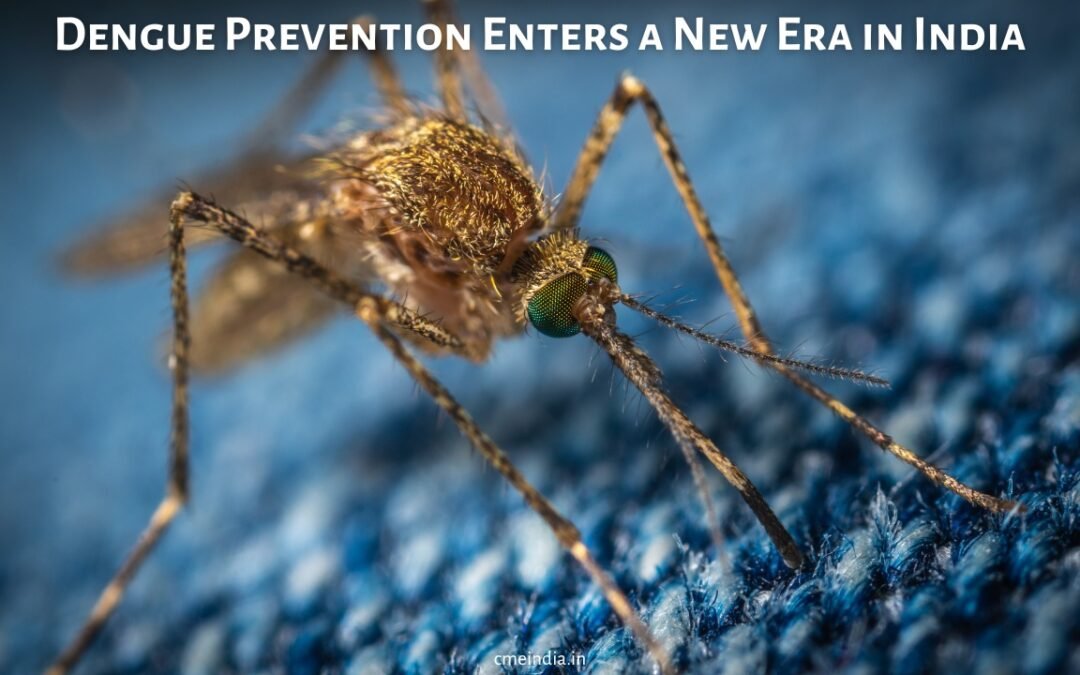
CME INDIA Presentation by Dr. N. K. Singh, MD, FICP, Director, Diabetes and Heart Research Centre, Dhanbad, Jharkhand, India. Editor, www.cmeindia.in; Dr. Harish Moorjani, Consultant, Infectious Diseases, New York Medical College, Valhalla, USA.
Bottom line for the practising physician
On 20 July 2026 the Drug Controller General of India granted market authorisation to QDENGA (TAK-003) — the first dengue vaccine ever approved in India. It is a live-attenuated tetravalent vaccine, given as two subcutaneous doses three months apart, licensed for individuals aged 4 to 60 years, and, critically, it requires no pre-vaccination serological screening.
Its dominant and most reproducible benefit is prevention of hospitalisation and severe dengue. Protection against symptomatic infection is real but partial, and varies by serotype and by baseline serostatus. This is a disease-modifying vaccine, not a transmission-blocking one. Vector control, surveillance and early fluid management remain non-negotiable.
1. Why This Matters Now
India carries close to one-third of the global dengue burden. Reported case numbers have risen more than eleven-fold over the past two decades, and modelling consistently indicates that notified cases represent only a small fraction of true infections. All four dengue virus serotypes co-circulate across large parts of the country, and serotype dominance shifts unpredictably between seasons and between states. Until now, the Indian clinician had nothing to offer beyond vector control advice, early recognition and meticulous fluid management.
The DCGI approval of QDENGA shifts the conversation from purely reactive care to primary prevention. It also creates an immediate and predictable set of questions in the outpatient department: who should be offered this vaccine, who must not receive it, what patients should be told to expect, and what they should emphatically not be told. This document sets out the CME INDIA position on those questions, and places the vaccine within a therapeutic pipeline that is, for the first time, genuinely promising.
2. What Exactly Was Approved
| Parameter | Indian label / approved position |
| Product | QDENGA (TAK-003), Takeda Biopharmaceuticals India Pvt. Ltd. |
| Regulatory action | Market authorisation by DCGI under CT-20, New Drugs and Clinical Trials Rules 2019; announced 20 July 2026 |
| Vaccine class | Live-attenuated, tetravalent, recombinant dengue vaccine |
| Indication | Prevention of dengue disease caused by any of the four DENV serotypes |
| Age range | 4 to 60 years |
| Schedule | Two 0.5 mL doses, subcutaneous, at month 0 and month 3 |
| Pre-vaccination testing | Not required. May be given irrespective of prior dengue exposure |
| Global footprint | Approved in 43 countries; WHO-prequalified; over 32 million doses distributed since 2022 |
| Post-marketing obligation | Region-wise and serotype-pattern post-marketing studies mandated to assess real-world effectiveness in India |
| Availability | Commercial rollout to follow supply and distribution arrangements; Takeda has partnered with Biological E to expand manufacturing capacity |
3. Construct and Immunological Rationale
QDENGA is built on a live-attenuated DENV-2 backbone, the DEN-2 PDK-53 strain. The remaining three vaccine viruses (TDV-1, TDV-3 and TDV-4) are chimeras: the premembrane and envelope genes of that DENV-2 backbone are replaced with the corresponding genes from wild-type DENV-1, DENV-3 and DENV-4. Every component therefore shares the same attenuated replication machinery while presenting serotype-specific surface antigens.
This design has two consequences the prescriber should hold in mind. First, because the non-structural proteins are DENV-2 derived across all four components, the vaccine elicits a broad cell-mediated response in addition to neutralising antibody. Second, and less favourably, the DENV-2 backbone replicates most efficiently, which contributes both to the consistently strongest efficacy signal against DENV-2 and to the weaker, less certain signals against DENV-3 and DENV-4 in dengue-naive recipients.
The earlier chimeric yellow-fever-backbone vaccine was restricted to individuals with documented prior dengue infection because of the risk of severe disease in seronegative recipients. QDENGA was developed specifically to avoid that constraint, and the absence of a screening requirement is its single most important operational advantage in Indian practice.
4. The Efficacy Evidence: TIDES (DEN-301)
The pivotal evidence comes from TIDES (NCT02747927), a phase 3, randomised, double-blind, placebo-controlled trial in 20,071 healthy participants aged 4 to 16 years across eight dengue-endemic countries in Asia and Latin America, randomised 2:1 to vaccine or placebo. Approximately 27.6 per cent were seronegative at baseline. Active febrile-illness surveillance with serotype-specific RT-PCR captured both outpatient and hospitalised dengue.
| Cumulative efficacy to 4.5 years | Virologically confirmed dengue | Hospitalised dengue |
| Overall population | 61.2% (95% CI 56.0–65.8) | 84.1% (95% CI 77.8–88.6) |
| Baseline seropositive | 64.2% (95% CI 58.4–69.2) | 85.9% (95% CI 78.7–90.7) |
| Baseline seronegative | 53.5% (95% CI 41.6–62.9) | 79.3% (95% CI 63.5–88.2) |
Follow-up has since been extended to seven years, including a booster dose administered at 4.5 years. The booster raised efficacy against virologically confirmed dengue modestly to approximately 74 per cent, and efficacy against dengue-related hospitalisation to approximately 91 per cent. A booster dose does not form part of the current Indian label and should not be offered outside a defined protocol.
4.1 Serotype-specific performance — the honest reading
- In baseline seropositive participants, efficacy against symptomatic dengue was demonstrated against all four serotypes, ranging from about 52 per cent for DENV-3 to about 80 per cent for DENV-2.
- In baseline seronegative participants, efficacy was demonstrated against DENV-1 (about 45 per cent) and DENV-2 (about 88 per cent). No efficacy was demonstrated against DENV-3, and DENV-4 case numbers were too few to permit any conclusion.
- Efficacy against hospitalisation in seropositive participants was consistent across all four serotypes, from about 67 per cent for DENV-1 upward, although some serotype-specific estimates rest on very small case numbers.
- A signal of reduced risk of a second symptomatic episode was also seen among vaccinated participants, suggesting an effect beyond prevention of the first episode. This remains hypothesis-generating rather than established.
| The single most important caveat The DENV-3 and DENV-4 data in dengue-naive recipients are the weak point of the evidence base, and India is a country in which DENV-3 and DENV-4 outbreaks occur. This is precisely why the regulator has mandated post-marketing effectiveness studies by region and serotype. Counsel honestly: protection is substantial but incomplete, and a vaccinated patient with a febrile illness must still be evaluated for dengue. |
5. Safety, Precautions and Contraindications
Across a development programme of more than 28,000 participants, no important safety risks have been identified. In the 22 to 57 month window of TIDES, serious adverse events were reported in 5.0 per cent of vaccine recipients and 5.9 per cent of placebo recipients; no death was considered vaccine-related.
5.1 Expected reactogenicity
- Injection-site pain, erythema and swelling.
- Headache, myalgia and malaise.
- Low-grade fever, typically within the first few days.
- The great majority of reactions are mild and self-limiting. Patients should be told to expect them, so that a vaccine reaction is not mistaken for dengue itself.
5.2 Do not vaccinate
| Situation | CME INDIA guidance |
| Significant immunosuppression | Contraindicated — this is a live vaccine. Includes congenital or acquired immunodeficiency, advanced or uncontrolled HIV, active haematological or generalised malignancy, and immunosuppressive therapy including high-dose corticosteroids and biologics. |
| Pregnancy | Not recommended. Avoid pregnancy for at least one month after each dose in women of childbearing potential, unless future national recommendations state otherwise. |
| Breastfeeding | Not recommended, in the absence of adequate data. |
| Age outside 4–60 years | Outside the Indian label. Do not administer. |
| Acute moderate or severe febrile illness | Defer until recovery. Minor illness is not a reason to defer. |
| Severe hypersensitivity to a component or a previous dose | Contraindicated. |
5.3 Practical timing and co-administration points
- Maintain a minimum interval of four weeks from any other live parenteral vaccine if not co-administered on the same day.
- Following blood products or immunoglobulin, defer according to standard live-vaccine principles.
- The second dose is due at three months. Completion of the two-dose course should be actively tracked; a single dose must not be assumed protective.
- Recent dengue infection is not a contraindication, but it is reasonable to allow clinical recovery before vaccination.
6. Who Should Be Offered QDENGA in Indian Practice
The Indian label is broad. In the absence of a national immunisation recommendation, clinical prioritisation should follow expected benefit. CME INDIA suggests the following practical hierarchy for opportunistic, individual-level vaccination.
| Priority | Group | Rationale |
| High | Residents of high-transmission urban and peri-urban districts with repeated seasonal outbreaks | Highest absolute risk of hospitalisation; most adults in these settings are already seropositive, the group in whom efficacy is best |
| High | Adolescents and adults with prior laboratory-confirmed dengue | Secondary infection carries the greatest risk of severe disease; efficacy is highest and most consistent in seropositive individuals |
| High | Adults with diabetes, obesity, chronic kidney disease, cardiovascular or chronic liver disease | Comorbidity substantially raises the risk of severe dengue and prolonged hospitalisation |
| Moderate | Healthcare workers and residents of institutional settings in endemic districts | Occupational exposure and continuity-of-service considerations |
| Moderate | Travellers from non-endemic to highly endemic areas, within the licensed age range | Requires completion of the schedule well before travel; not a last-minute intervention |
| Individualise | Dengue-naive children in low-transmission areas | Weaker and less certain serotype coverage in seronegatives; discuss the uncertainty explicitly |
Note on serostatus. The label does not require testing, and CME INDIA does not recommend routine pre-vaccination serology, which would add cost and delay without changing eligibility. Serostatus remains clinically relevant only as a counselling variable, because expected benefit is somewhat greater in the previously exposed.
7. What the Vaccine Does Not Do
This section exists because unrealistic expectation is the likeliest source of clinical and reputational harm during the first year of rollout.
- It does not reliably prevent infection. It reduces symptomatic disease and, above all, severe disease and hospitalisation.
- It is not transmission-blocking. It will not by itself terminate outbreaks or replace vector control.
- It does not remove the need to test. Fever in a vaccinated patient in an endemic district is dengue until proven otherwise.
- It does not deliver uniform protection across serotypes, particularly in the dengue-naive.
- Two doses over three months means protection is not immediate. It is a pre-season intervention, not an outbreak-response tool for the individual patient.
8. The Therapeutic Pipeline: Antivirals and Monoclonals
For the first time, dengue has a credible direct-acting antiviral pipeline alongside vaccination. Nothing in this section is available for clinical use, and none of it should be requested or promised to patients. It is presented because the direction of travel now materially affects how the specialty should plan.
8.1 Mosnodenvir (formerly JNJ-1802)
An oral, pan-serotype small molecule that blocks viral replication by preventing the interaction between the non-structural proteins NS3 and NS4B, thereby preventing the formation of new viral RNA. It demonstrates picomolar to low-nanomolar in vitro potency across all four serotypes.
In a phase 2a, double-blind, randomised controlled human infection model trial, healthy adults received low, medium or high-dose oral mosnodenvir or placebo and were then inoculated subcutaneously with an underattenuated DENV-3 strain. The proportion of participants showing no signs of DENV-3 infection was 60 per cent in the high-dose group, compared with none of the placebo recipients. High-dose mosnodenvir produced a significantly lower DENV-3 RNA load than placebo, and no serious adverse events occurred.
Two cautions temper this result. Emergent amino acid variations in the NS4B region were detected in all mosnodenvir recipients with available sequencing data and in none of the placebo recipients, raising a resistance question that must be resolved. Separately, development has slowed after Johnson & Johnson deprioritised infectious diseases, and efforts are under way to find another partner to bring the candidate to market.
8.2 EYU688 (formerly NITD-688)
A Novartis compound that also targets the viral replication complex. Mechanistic work has shown that it disrupts the critical NS3–NS4B interaction constituting the replication factory of the virus, halting infection. It has entered phase 2 evaluation aimed at patients presenting early, within 48 hours of fever onset — the therapeutic window that matters most clinically, and the one Indian practice is unusually well placed to capture given how early febrile patients present here.
8.3 Monoclonal antibodies
The Serum Institute of India is advancing a dengue monoclonal antibody through phase 3 evaluation. If licensed, a single early dose could confer immediate protection lasting months — a fundamentally different proposition from a two-dose vaccine requiring three months to complete, with obvious application in outbreak containment, in household contacts, and in patients for whom a live vaccine is contraindicated.
8.4 Other vaccines in development
The single-dose live-attenuated tetravalent Butantan–Dengue Vaccine has reported phase 3 efficacy of approximately 79.6 per cent in Brazilian participants aged 2 to 59 years, with a subsequent extended follow-up publication. A single-dose product would materially simplify programmatic delivery if these results are sustained and if the vaccine becomes available in this region.
9. The Neglected Population: Dengue in the Older Adult
With an ageing population in India and globally, dengue in older adults is an urgent and under-addressed clinical problem. Older patients present atypically, more often carry comorbidity that complicates fluid management, tolerate plasma leakage and shock poorly, and are more likely to be taking anticoagulants, antiplatelets, renin–angiotensin blockers and diuretics that alter both bleeding risk and haemodynamic reserve. There is an acknowledged and increasing need for comprehensive, practical guidance on the diagnosis, treatment, prevention and control of dengue in this group.
The Indian label extends to 60 years, which covers a substantial part of this population but stops short of the oldest and most vulnerable. CME INDIA regards this as a priority gap for future evidence generation and, if data permit, for label extension.
10. Unanswered Questions and the Indian Research Agenda
- Real-world effectiveness in India by region and by circulating serotype, as mandated by the regulator, with particular attention to DENV-3 and DENV-4.
- Effectiveness and safety in adults above 45 years, for whom the pivotal trial provides no direct data, and the case for extension beyond 60 years.
- Performance in patients with diabetes, chronic kidney disease and obesity — the comorbidity profile that dominates Indian medical wards during outbreak season.
- The role, timing and necessity of a booster dose in the Indian epidemiological context.
- Cost-effectiveness, and the case for inclusion in state or national immunisation programmes in high-transmission districts.
- Interaction with prior Japanese encephalitis vaccination or other flavivirus exposure, given widespread JE vaccination in several Indian states.
- Resistance surveillance frameworks, in anticipation of direct-acting antivirals reaching the clinic.
11. CME INDIA Position Statements
- QDENGA (TAK-003) is endorsed as a clinically meaningful advance in dengue prevention in India. Its greatest value lies in the reduction of severe dengue and dengue-related hospitalisation.
- Pre-vaccination serological screening is not recommended. It adds cost and delay without altering eligibility under the Indian label.
- Counselling must be explicit about partial protection. Patients should be told that vaccination reduces but does not abolish the risk of dengue, and that any febrile illness still requires evaluation.
- The live-attenuated nature of the vaccine must be respected. Significant immunosuppression and pregnancy remain the principal barriers; a structured pre-vaccination checklist should be used at every administration.
- Vaccination supplements, and does not replace, vector control, surveillance, community awareness and early fluid management. The vaccine is disease-modifying, not transmission-blocking.
- Completion of the two-dose schedule should be actively tracked through recall systems, as a single dose cannot be assumed protective.
- Booster dosing is not part of the current Indian label and should not be administered outside a defined protocol.
- Antivirals and monoclonal antibodies are not yet available and must not be promised to patients — but the specialty should prepare for their arrival, including through early-presentation pathways and resistance surveillance planning.
- Post-marketing pharmacovigilance is a professional obligation. Adverse events following immunisation, and breakthrough severe dengue in vaccinated individuals, should be reported.
CME INDIA Take-Home Message
QDENGA is the first dengue vaccine India has ever had. Its broad serotype coverage, simple two-dose schedule and — above all — its use without pre-vaccination testing make it operationally deliverable in ordinary Indian practice. The public health return will come principally through fewer severe cases and fewer hospital admissions, not through elimination of dengue.
Offer it honestly. Prioritise those in high-transmission districts, those with prior dengue, and those whose comorbidity makes severe disease likely. Screen carefully for immunosuppression and pregnancy. Complete both doses. And keep treating every fever in an endemic district as dengue until proven otherwise.
Contributors
| Dr. N. K. Singh | CME INDIA — concept, drafting and clinical positioning |
| Dr. Harish Moorjani | Consultant, Infectious Diseases, New York Medical College, Valhalla, USA — virology, evidence appraisal and pipeline review |
Disclaimer. This document is an educational communication of CME INDIA intended for registered medical practitioners. It summarises published evidence and regulatory information available up to 21 July 2026 and does not replace the approved product label, prevailing national immunisation policy, or individual clinical judgement. Prescribers must consult the current Indian package insert before administration.
References
1. Takeda Biopharmaceuticals India Pvt. Ltd. Takeda’s QDENGA (TAK-003) becomes the first dengue vaccine to be approved in India. Press release; 20 July 2026. https://indiamedtoday.com/takedas-qdenga-tak-003-becomes-the-first-dengue-vaccine-to-be-approved-in-india/
2. India gets its first dengue vaccine as DCGI approves Takeda’s QDENGA. Medical Dialogues; 20 July 2026. https://medicaldialogues.in/news/industry/pharma/india-gets-its-first-dengue-vaccine-as-dcgi-approves-takedas-qdenga-175400
3. Tricou V, Yu D, Reynales H, et al. Long-term efficacy and safety of a tetravalent dengue vaccine (TAK-003): 4.5-year results from a phase 3, randomised, double-blind, placebo-controlled trial. Lancet Glob Health. 2024;12(2):e257–e270. https://doi.org/10.1016/S2214-109X(23)00522-3
4. Biswal S, Reynales H, Sáez-Llorens X, et al. Efficacy of a tetravalent dengue vaccine in healthy children and adolescents. N Engl J Med. 2019;381(21):2009–19. https://doi.org/10.1056/NEJMoa1903869
5. Patel SS, Rauscher M, Kudela M, et al. TAK-003: development of a tetravalent dengue vaccine. Expert Rev Vaccines. 2025;24(1):345–60. https://doi.org/10.1080/14760584.2025.2490295
6. Wallace D, Rauscher M, Folschweiller N, et al. The TAK-003 story: key decisions that shaped development of a tetravalent dengue vaccine. npj Vaccines. 2026;11:60. https://doi.org/10.1038/s41541-025-01366-9
7. Sáez-Llorens X, Biswal S, Borja-Tabora C, et al. Effect of the tetravalent dengue vaccine TAK-003 on sequential episodes of symptomatic dengue. Am J Trop Med Hyg. 2023;108(5):1033–6. https://doi.org/10.4269/ajtmh.22-0673
8. Vanhoutte F, Ackaert O, Kakuda TN, et al. Daily mosnodenvir as dengue prophylaxis in a controlled human infection model. N Engl J Med. 2025. https://doi.org/10.1056/NEJMoa2500179
9. Kaptein SJF, Goethals O, Kiemel D, et al. A pan-serotype dengue virus inhibitor targeting the NS3–NS4B interaction. Nature. 2021;598:504–12. https://doi.org/10.1038/s41586-021-03990-6
10. University of Texas Medical Branch. UTMB research uncovers how drug candidate stops dengue infection. UTMB News; 28 March 2025. https://www.utmb.edu/news/article/utmb-news/2025/03/28/utmb-research-uncovers-how-drug-candidate-stops-dengue-infection
11. Kallas EG, Cintra MAT, Moreira JA, et al. Live, attenuated, tetravalent Butantan–dengue vaccine in children and adults. N Engl J Med. 2024;390(5):397–408. https://doi.org/10.1056/NEJMoa2301790
12. Dengue in older adults: an unmet need for comprehensive, practical clinical guidance on diagnosis, treatment, prevention and control. Emerg Microbes Infect. 2026. https://doi.org/10.1080/22221751.2026.2622217
13. World Health Organization. Dengue vaccine: WHO position paper — May 2024. Wkly Epidemiol Rec. 2024;99(18):203–24. https://www.who.int/publications/i/item/who-wer9918-203-224
14. Takeda phase 3 TIDES trial confirms long-term efficacy and safety of QDENGA, including booster-dose data. Applied Clinical Trials; 2026. https://www.appliedclinicaltrialsonline.com/view/takeda-tides-trial-confirms-long-term-efficacy-safety-qdenga-dengue-vaccine
Discover CME INDIA

- Explore CME INDIA Repository
- Examine CME INDIA Case Study
- Read History Today in Medicine
- Register for Future CMEs
What is cost and availability of vaccine
First half of 2027 cost could be 6000 to 12000